
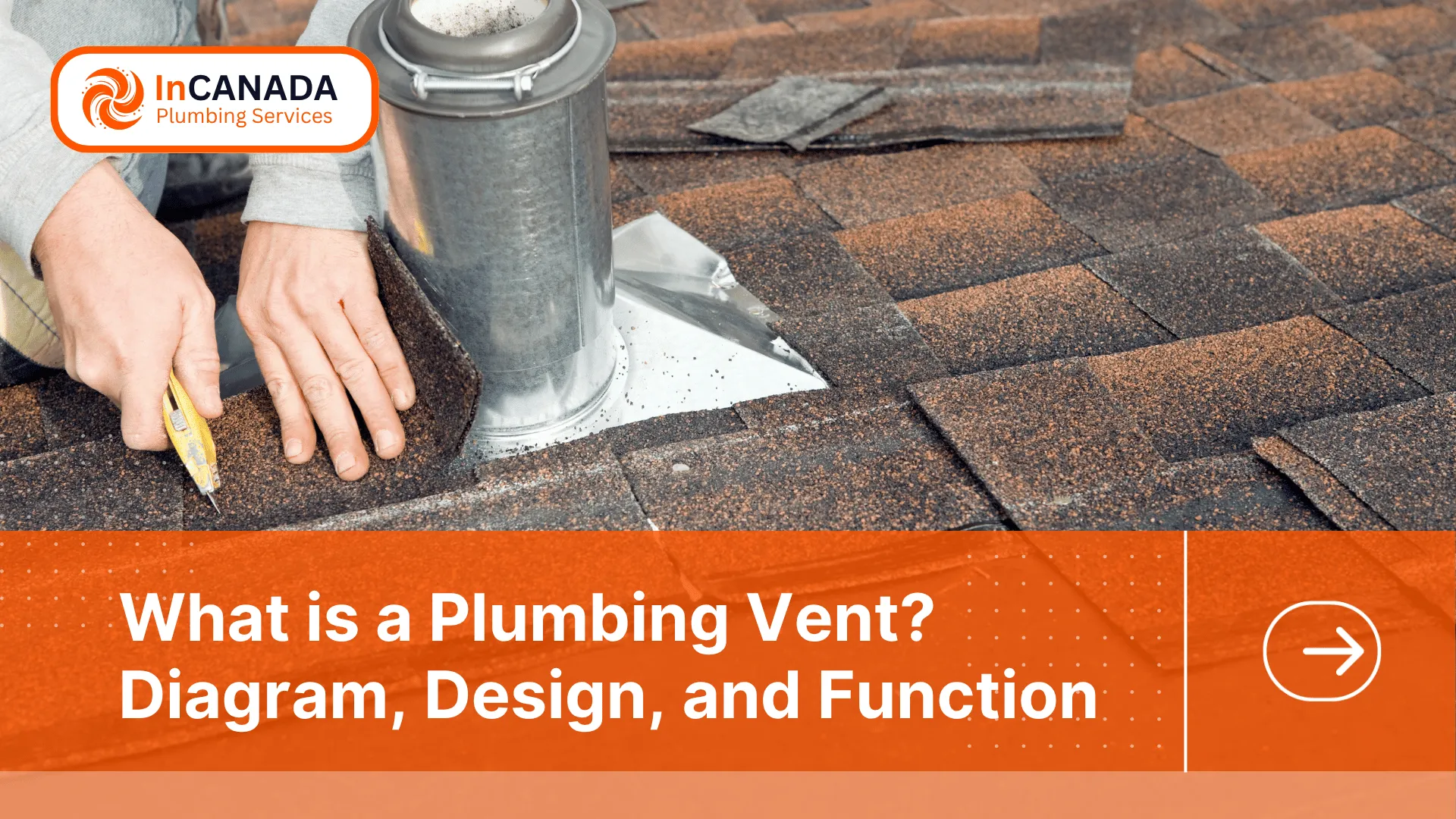
A plumbing vent is a pipe path that connects the drain-waste system to open air, so drains keep steady airflow and traps keep their water seal. The vent system protects trap seals that codes set at 2 to 4 inches 51 to 102 mm of water depth, so sewer gases stay on the far side of the trap. Vent layout is not guesswork: the International Code Council’s PMG guidance for the 2021 International Plumbing Code notes that approved vent methods were laboratory tested for sizing and installation rules, then field tested through long service history. I covers vent function, parts, vent types, common failures, benefits, vent vs stack terms, when a vent is required, approved vent methods, maintenance, and typical install costs. Each heading starts with a direct first-sentence answer, then details follow.
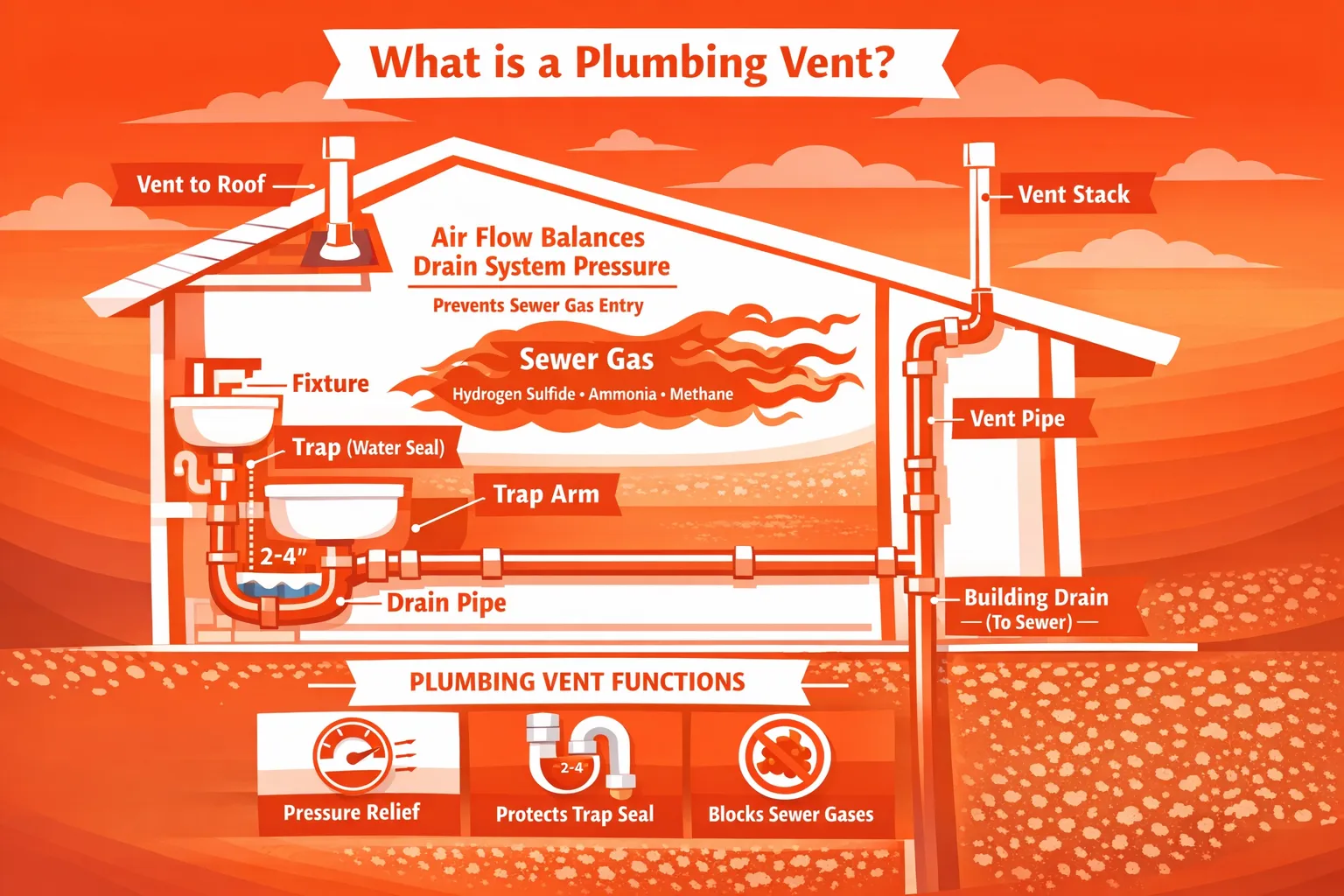
Quick diagram DWV basics:
Fixture → trap water seal → trap arm horizontal → drain stack/building drain
Vent connection ties into the trap arm or fixture drain within a code-set distance
Vent piping rises and joins a vent stack or stack vent, then terminates outdoors above the rona pressure-balancing air path for a drain system that opens to the outdoors and protects fixture traps from siphonage and backpressure.
In the International Plumbing Code framing, “traps and trapped fixtures shall be vented” by an allowed method, and at least one vent pipe must extend to the outdoors for the building drain’s vent system.
What Is The Function Of Plumbing Vent?
The function of a plumbing vent is to keep air pressure near atmospheric inside drainage piping so water traps keep their seal.
A lost trap seal lets sewer gas enter occupied space; public health agencies note sewer gas mixtures may include hydrogen sulfide and ammonia. exposure has documented health hazards, with risk rising as concentration rises.
A vent system reduces the pressure swings that pull water out of traps or push air through fixtures.
What Are The Components Of Plumbing Vent?
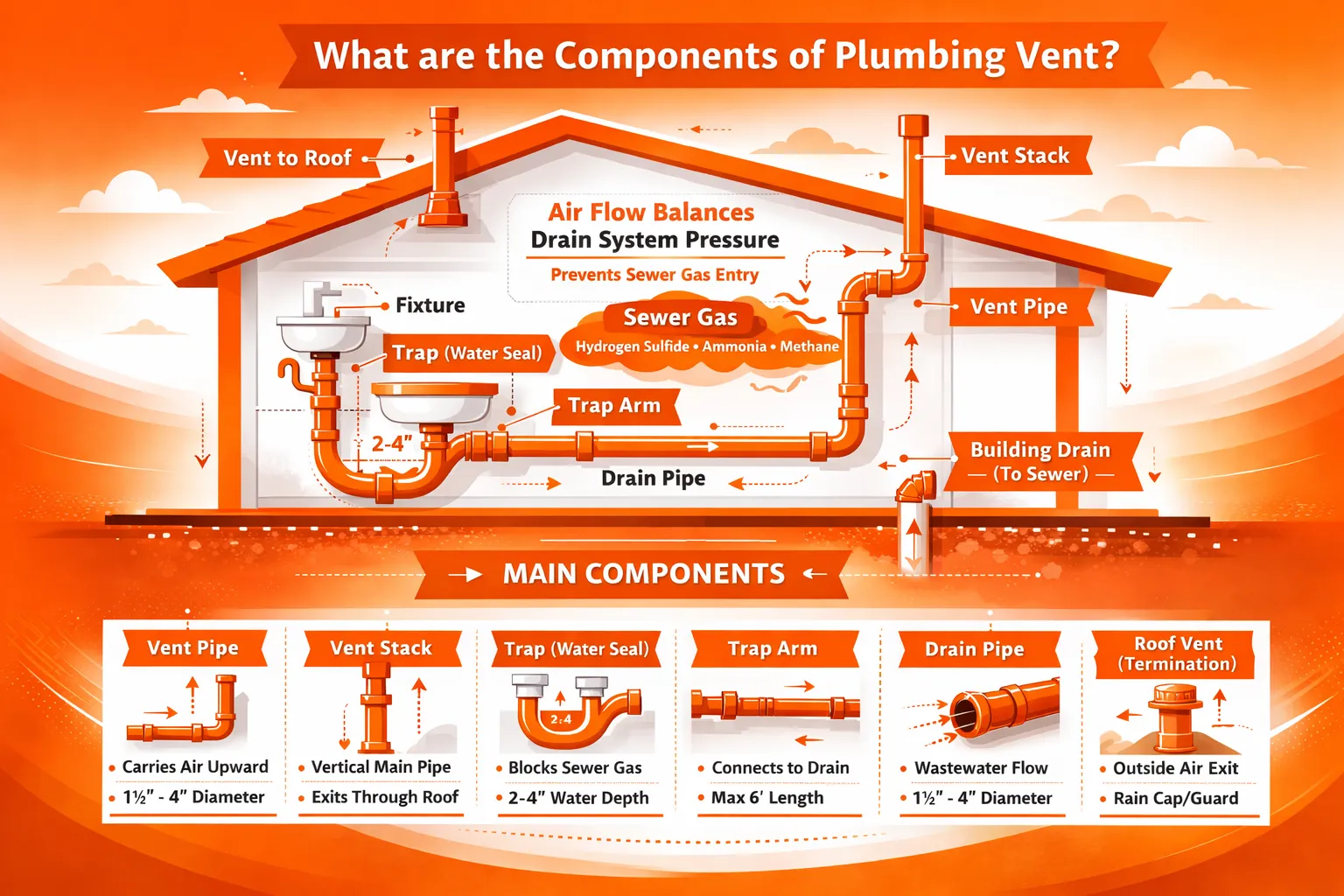
The components of a plumbing vent are the vent piping, fittings, connection points to drains, and the outdoor termination assembly.
Key components with the job each part does:
Individual vent: a pipe that vents a single fixture trap and ties into the vent system or terminates outdoors.
Branch vent: a vent that connects one or more individual vents to a vent stack or stack vent.
Vent stack: a vertical vent pipe installed mainly to circulate air to and from parts of the drainage system.
Stack vent: the extension of a soil or waste stack above the highest horizontal drain connection.
Vent fittings: sanitary tees, wyes, and approved vent fittings that keep airflow smooth and keep condensate drainage sensible codes treat some low vent sections like drainage. lorisweb.com
Roof penetration parts: flashing and weather seal at the roof line; code text calls for approved flashing and watertight roof junctions. shop.iccsafe.org
Vent terminal: the outdoor end of the vent. Location rules apply near doors, windows, and air intakes. ICC Digital Codes
What Are The Types Of Plumbing Vent?
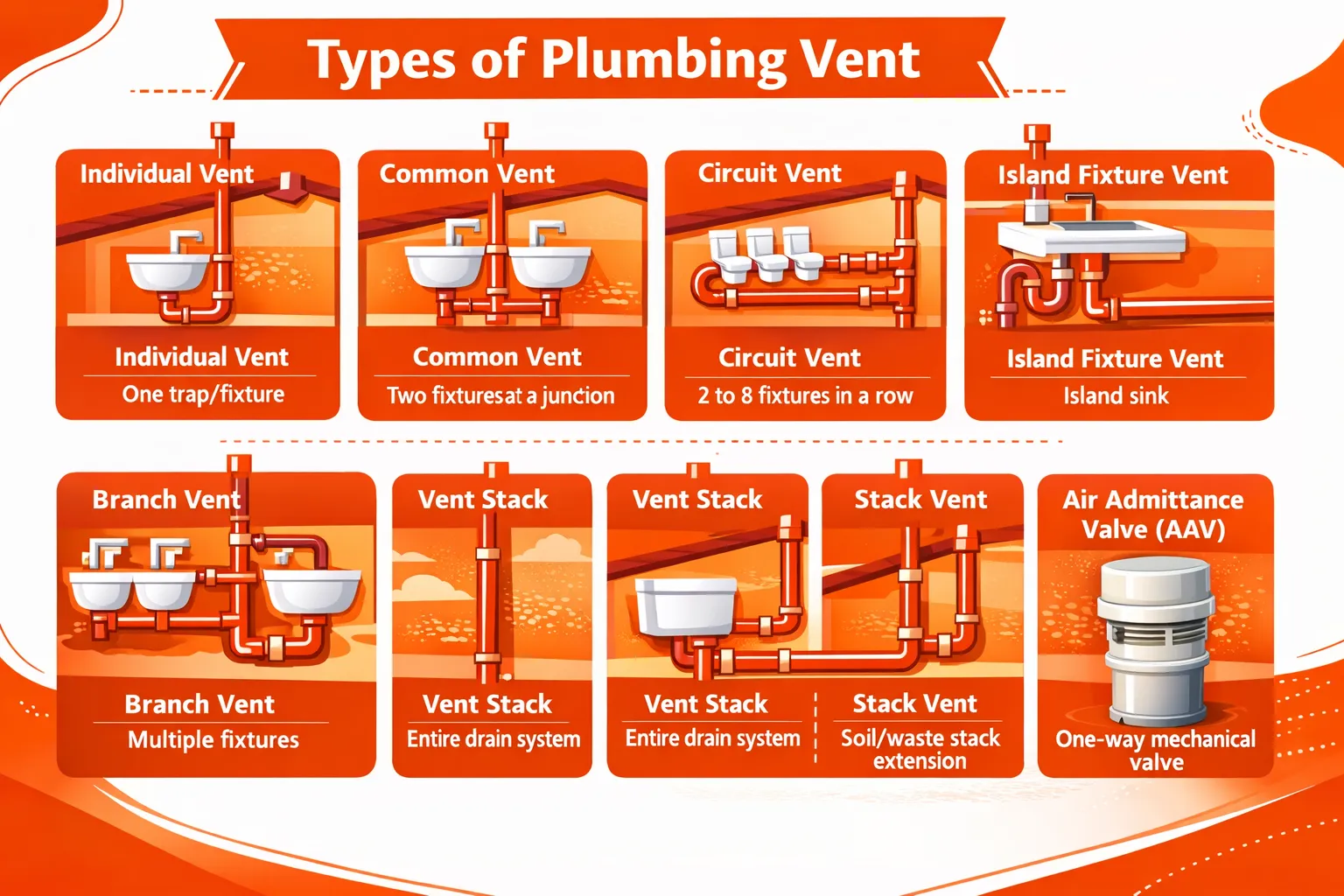
The types of plumbing vent are individual vents, shared vents, stack-based vents, and special-purpose vents such as circuit or island fixture vents.
The table below lists common vent types and the practical reason each exists.
| Vent type | What it serves | Why it exists plain function |
|---|---|---|
| Individual vent | One trap/fixture | Keeps that trap seal stable, simplest layout |
| Common vent | Two fixtures at a junction | Shares one vent path for two traps |
| Branch vent | Multiple individual vents | Collects vents and routes to a stack vent/vent stack |
| Vent stack | Drainage system zones | Adds air circulation and pressure relief in taller stacks |
| Stack vent | Soil/waste stack extension | Lets a stack breathe above the highest branch |
| Circuit vent | 2 to 8 fixtures on a horizontal branch | Uses one vent for a “battery” of fixtures |
| Island fixture vent | Island sink or similar | Handles fixtures where a normal vertical vent path is hard |
| Air admittance valve AAV | Local vent substitute for negative pressure | Opens under negative pressure, closes by gravity to block sewer gases Standards Global |
What Are The Common Issues Of Plumbing Vent?
Common plumbing vent issues are blockage, sizing errors, bad placement, and termination mistakes that cause trap seal loss or poor drainage.
Common issue patterns symptom → technical cause:
Gurgling fixture → trap arm not vented within code distance, or vent path restricted.
Sewer odor indoors → trap seal loss evaporation or siphonage or failed mechanical vent device. Trap seal limits exist for a reason: 2 to 4 inches is the code band in UPC text.
Slow drain → vent restriction that traps air and limits flow.
Roof-area moisture damage near a vent penetration → failed flashing or boot at roof penetration water entry path at the roof joint.
Cold climate frost closure → vent terminal diameter too small for climate rules; model code language addresses larger vent extensions for frost risk zones. shop.iccsafe.org
What Are The Benefits Of Plumbing Vent?
The benefits of a plumbing vent are stable trap seals, fewer drainage pressure problems, and controlled discharge of sewer gases to outdoors.
Key benefits with measurable anchors:
Trap seal protection: traps hold a 2 to 4 inch water seal per UPC text, and a vent reduces pressure swings that break that seal.
Lower odor entry risk: sewer gas contains hazardous components such as hydrogen sulfide and ammonia in many cases, so keeping traps sealed matters. Wisconsin Department of Health Services
Safer gas discharge: methane has a 5% by volume lower explosive limit in air, so confined accumulation is a known hazard category; proper venting routes gases outdoors instead of into enclosed spaces. pca.state.mn.us
Traditional reliability: an open-air vent through the roof relies on gravity and open air, not moving parts AAVs use moving seals and have defined performance standards. Standards Global
What Is The Difference Between Plumbing Vent And Stack?
The difference between a plumbing vent and a stack is role and flow: vents move air, stacks often carry waste plus air depending on the stack type.
Vent general term: piping intended to move air to protect traps and equalize pressure.
Vent stack: a vertical vent pipe for air circulation across the drainage system.
Stack vent: the extension of a soil or waste stack above the highest horizontal drain connection.
Soil or waste stack: a vertical pipe that carries discharge from fixtures down toward the building drain.
If the house had a family tree, the stack is the trunk, the vents are the lungs, and the traps are the bouncers who do not let sewer gas enter without a wristband.
When Do You Need For Plumbing Vent?
You need a plumbing vent whenever a fixture trap exists, because plumbing codes require trapped fixtures to have an approved vent method.
Two code-driven triggers show up in practice:
New fixture or remodel: the trap arm must connect to a vent within the allowed distance for its size and slope.
Longer or taller stacks: vent stack requirements rise with stack height and branch intervals, since pressure differences rise in tall stacks.
The next table gives the IPC maximum distance from a fixture trap to its vent connection Table 909.1 in the ICC PMG 2021 IPC guide.
| Trap size inches | Slope inch per foot | Max distance trap to vent feet |
|---|---|---|
| 1¼ | ¼ | 5 |
| 1½ | ¼ | 6 |
| 2 | ¼ | 8 |
| 3 | 1/8 | 12 |
| 4 | 1/8 | 16 |
What Are The Different Venting Methods?
Different venting methods are conventional venting, wet venting, circuit venting, waste stack venting, and mechanical venting by listed AAV devices where allowed.
The ICC PMG 2021 IPC guide states that Chapter 9 permits multiple approaches and notes laboratory and field test history behind these methods.
Common permitted method families:
Conventional venting individual vents: most common, each trap gets an individual vent tied into the vent system.
Horizontal wet venting: one pipe serves as drain plus vent air path for a group, with fitting rules and sizing limits.
Circuit venting: one vent serves up to eight fixtures on one floor; ICC PMG cites research at the State University of Iowa and Roy B. Hunter’s National Bureau of Standards work as part of the method history.
Waste stack venting / stack venting: uses the soil or waste stack as the vent path under defined limits.
Air admittance valves AAVs: one-way devices that open under negative pressure and close by gravity under zero or positive pressure to block sewer gases; standards describe that operation. Standards Global
How To Maintain Plumbing Vent?
To maintain a plumbing vent, inspect terminations and trap seals, clear obstructions, and keep roof penetrations watertight. homeinspector.org
A practical maintenance checklist:
Inspect roof area twice per year spring and fall is a common cycle referenced in home inspection guidance citing NRCA advice. homeinspector.org
Confirm vent terminal clearances from doors, openable windows, and air intakes; IPC text sets 10 feet horizontal unless the terminal sits 3 feet above the opening. ICC Digital Codes
Check trap seals in little-used fixtures; traps rely on a 2 to 4 inch seal depth in UPC text, so a dry trap is a real failure mode.
Clear obstructions at vent terminals leaves, nests, debris using safe roof access rules.
Inspect flashing and boots at roof penetrations for cracking, gaps, or lifted edges that admit water at the roof joint.
What Is The Cost Of Installing Plumbing Vent?
The cost of installing a plumbing vent is driven by access, roof work, wall repair, number of fixtures, and whether you add a new roof penetration or tie into an existing vent path. Angi
The table below lists common vent-related work items with typical U.S. cost ranges from published cost datasets.
| Work item | Typical cost range USD | What changes the price most |
|---|---|---|
| Install a roof vent per run | $640 to $784 Jan 2026 baseline Homewyse | Roof access, pitch, interior routing |
| Install a roof vent per line | $436.64 to $542.62 Porch national range Porch | Local labor rates, finish repair |
| Replace roof vent boot | Normal range $250 to $600, with wider cases $150 to $1,200 Angi | Roof material, height, hidden deck repair |
Cost note: a simple tie-in inside a wall often costs less than any job that needs a new roof penetration, because roof work adds flashing labor and finish repair.
Comments (0)
Comments are disabled.