
A plumbing stack is the home’s main vertical drain-and-vent path: it carries wastewater down to the building drain, keeps air pressure stable so traps keep their water seal, and routes sewer gases up and out through the roof. Typical stack layouts use a soil or waste stack, a stack vent above the highest branch connection, cleanouts near the base, and branch drains from toilets, sinks, tubs, and showers. Codes size stacks by fixture load, and costs change with height, access, wall repair, permits, and pipe material, with U.S. homeowner pricing guides reporting about $1,500 to $15,000 for replacement work on many homes.
What Is A Plumbing Stack?
A plumbing stack is a vertical pipe system that connects fixture drains to the building drain and connects the drain system to open air through venting. In code language, the stack is part of the drain-waste-vent network that depends on gravity flow plus controlled air movement to keep traps from losing their seal. Federal manufactured-housing plumbing rules describe the same principle: traps require protection from siphonage and back pressure, and vents ensure air circulation through the drainage system.
What Is The Function Of A Plumbing Stack?
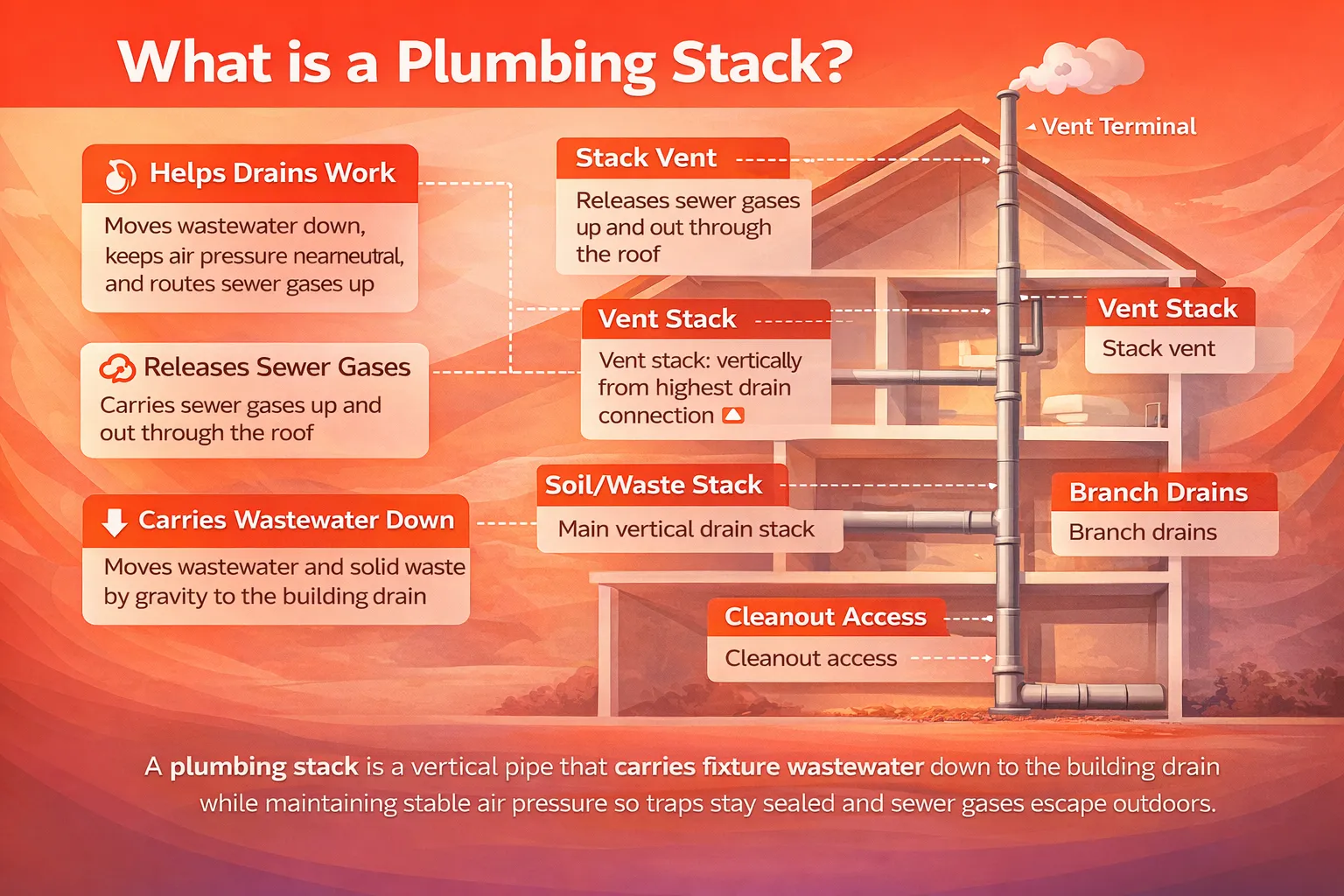
The function of a plumbing stack is to move wastewater down while keeping air pressure near neutral so drains run fast and traps stay sealed. That job has 3 parts:
Carry discharge to the building drain: Wastewater and solids drop through the vertical stack to the building drain and then to sewer or septic.
Protect trap seals: Vent paths prevent siphon and back pressure at fixture traps, which is explicitly required in federal venting rules.
Release sewer gases outdoors: A vent path reduces indoor sewer gas risk; hydrogen sulfide, a sewer-associated gas, has an odor threshold people often notice at low concentrations, yet odor detection fails at high concentration because smell fatigue can occur. CDC
A short reality check: the stack does not “make” drains work by magic. The stack makes drains work by air and gravity, which is less exciting than magic, yet more reliable.
What Are The Components Of A Plumbing Stack?
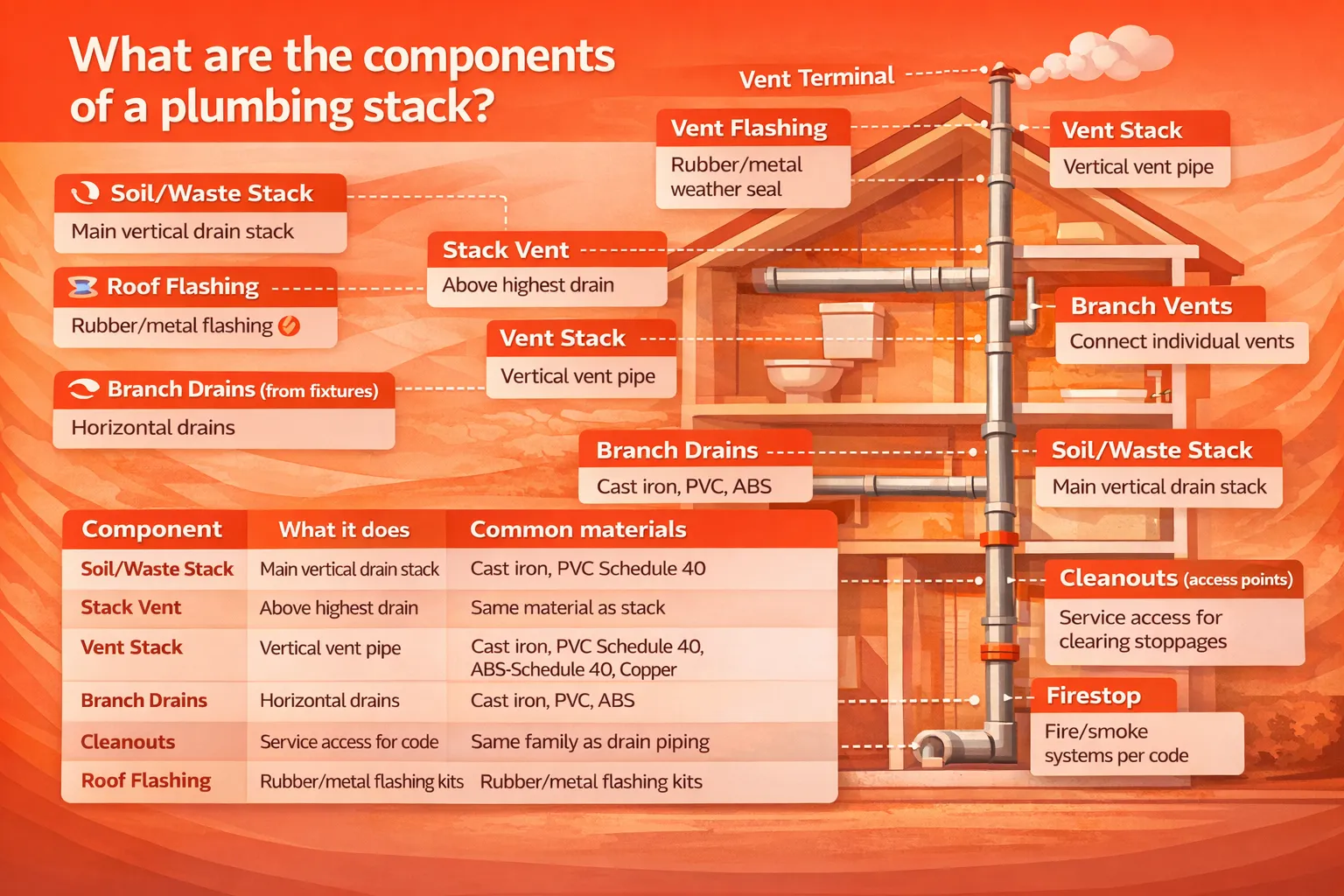
The components of a plumbing stack are the vertical drain stack, the vent portion above the highest branch, fixture branches, fittings, supports, and service access points cleanouts.
The table cover the major stack parts, what each part does, and common materials that codes accept for vent piping.
| Component | What it does | Common materials examples |
|---|---|---|
| Soil or waste stack | Main vertical drain path for fixture discharge | Cast iron, PVC Schedule 40, ABS Schedule 40 |
| Stack vent | Extension of soil/waste stack above the highest horizontal drain connection | Same material as stack, sized by code method ICC |
| Vent stack | Vertical vent pipe used primarily for air circulation to and from the drain system | Cast iron, PVC/ABS Schedule 40, copper DWV, galvanized steel varies by code and jurisdiction ICC eCFR |
| Branch drains | Horizontal drains from fixtures to the stack | Cast iron, PVC, ABS |
| Branch vents | Connect individual vents to a vent stack or stack vent | Same family as vent piping ICC |
| Cleanouts | Service access for clearing stoppages | Same family as drain piping |
| Roof flashing/boot | Weather seal at roof penetration | Rubber/metal flashing kits roof system dependent |
| Firestop at penetrations | Limits fire/smoke spread between floors | Firestop systems per building code, installation specific |
Sizing note with a hard code example: the 2021 International Plumbing Code section on stack sizing states that the stack vent is the same size as the drainage stack, and it gives a fixture-limit example: a 3-inch stack serves not more than two water closets in that section excerpt.
What Are The Types Of Plumbing Stacks?
The types of plumbing stacks are defined by what they carry and where they sit in the drain and vent path.
Soil stack: Stack that carries discharge that includes toilets soil.
Waste stack: Stack that carries discharge from fixtures other than toilets.
Combined soil and waste stack: Single stack that carries both toilet discharge and other fixture discharge common in many homes.
Stack vent: “The extension of a soil or waste stack above the highest horizontal drain connected to the stack.” ICC
Vent stack: “A vertical vent pipe installed primarily for the purpose of providing circulation of air to and from any part of the drainage system.” ICC
What Are Common Plumbing Stack Problems?
Common plumbing stack problems fall into 6 buckets:
Corrosion and wall loss cast iron: Corrosion is a dominant failure mechanism in cast iron pipe research and service-life work. ScienceDirect
Hydrogen sulfide corrosion in wastewater systems: EPA technical material notes hydrogen sulfide corrosion can drive premature replacement or rehab for wastewater assets. EPA NEPIS
Joint leaks: Failed couplings, hub-and-spigot issues, cracked fittings, failed gaskets.
Blockage: Grease, scale, wipes, construction debris, offsets at floor penetrations.
Vent obstruction: Leaves, bird nests, frost closure in cold climates, collapsed vent sections.
Support failure: Loose clamps, settling, poor alignment at offsets, leading to stress cracks.
What Are The Benefits Of A Plumbing Stack?
The benefits of a plumbing stack are stable drainage, trap seal protection, odor control, safer pressure balance, and easier service access.
Faster drainage: Air movement reduces pressure swings that slow flow.
Trap protection: Vents protect traps from siphonage and back pressure, which federal rules explicitly require for trapped fixtures. eCFR
Lower sewer gas entry risk: Sewer gas hazards exist in wastewater settings; public health guidance notes hydrogen sulfide odor detection fails at high levels, so correct vent design matters more than “sniff tests.” CDC
Code compliance: Many jurisdictions follow IPC or UPC concepts; UPC training material highlights that vent and waste roles are distinct except in specific permitted systems. eofficial.org
Serviceability: Cleanouts and a clear stack path reduce time to clear stoppages.
What Is The Difference Between A Plumbing Stack And A Vent?
The difference between a plumbing stack and a vent is that the stack carries wastewater down, while the vent path moves air to protect traps and route gases up to open air. In definitions used in ICC technical guidance, a stack vent is part of the drain stack an extension above the highest branch, while a vent stack is a vertical vent pipe whose primary job is air circulation. ICC
Code separation matters: UPC training text states that, except for defined exceptions, a vent pipe is not used as a soil or waste pipe and a soil or waste pipe is not used as a vent. eofficial.org
When Do You Need A Plumbing Stack?
You need a plumbing stack whenever a building has plumbed fixtures that discharge to a building drain and requires venting to protect trap seals and maintain air movement. Plumbing guidance tied to IPC states the vent system serving each building drain has at least one vent pipe that extends outdoors. ICC
Common project triggers:
New bathroom or kitchen addition tied into existing drainage
Multi-story fixture groups that share a vertical drain path
Major remodel that relocates fixtures across floors
Replacement of failed cast iron stacks in older homes
How Do You Know A Plumbing Stack Is Leaking?
A plumbing stack leak shows up as water, odor, staining, or repeat drain issues near the stack line.
Here are 9 direct checks:
See stains: Brown or yellow staining on drywall near vertical pipe chases.
Find wet framing: Damp studs or subfloor near the stack base after fixture use.
Hear drip sounds: Drip noise inside a wall after toilet flush or shower drain.
Smell sewer odor: Hydrogen sulfide smells like rotten eggs at low concentrations, yet smell can disappear at higher concentration due to loss of smell ability, so odor absence does not clear the space. CDC
Spot rust scale: Rust streaks on cast iron hubs, white mineral tracks on PVC joints.
See loose couplings: Shifted no-hub couplings, bulged rubber sleeves.
Notice gurgle plus slow drain: Pressure swings or partial blockage.
See ceiling spots below bathrooms: Leak path from an upper-floor branch tie-in.
Confirm with a tool: Moisture meter, borescope, drain camera, or a licensed smoke test.
How Do You Maintain A Plumbing Stack?
Maintain a plumbing stack with routine inspection, basic cleaning, and early repair of small defects before wall damage grows.
Use this 8-step checklist:
Inspect roof vent opening: Check for leaves, nests, ice closure.
Flush traps: Run water in rarely used fixtures weekly to keep trap seals.
Clean branch lines: Use strainers, remove hair and soap buildup at fixtures.
Avoid grease dumping: Cool grease, discard in trash, not the sink.
Check cleanout caps: Confirm caps stay tight and gaskets stay intact.
Watch joint movement: Look for coupling shift after freezing or settlement.
Limit harsh chemicals: Repeated caustic use harms pipe and seals in many systems.
Schedule a camera check: Use inspection after repeat backups or after a major clog.
What Is The Cost Of Installing A Plumbing Stack System?
The cost of installing a plumbing stack system depends on stack height, access, wall repair, pipe material, permit and inspection rules, and how many fixture tie-ins exist. A U.S. homeowner cost guide reports a wide replacement range of about $1,500 to $15,000, with plumber rates reported around $75 to $200 per hour, and a simple job reported at 8 to 12 hours in that guide.
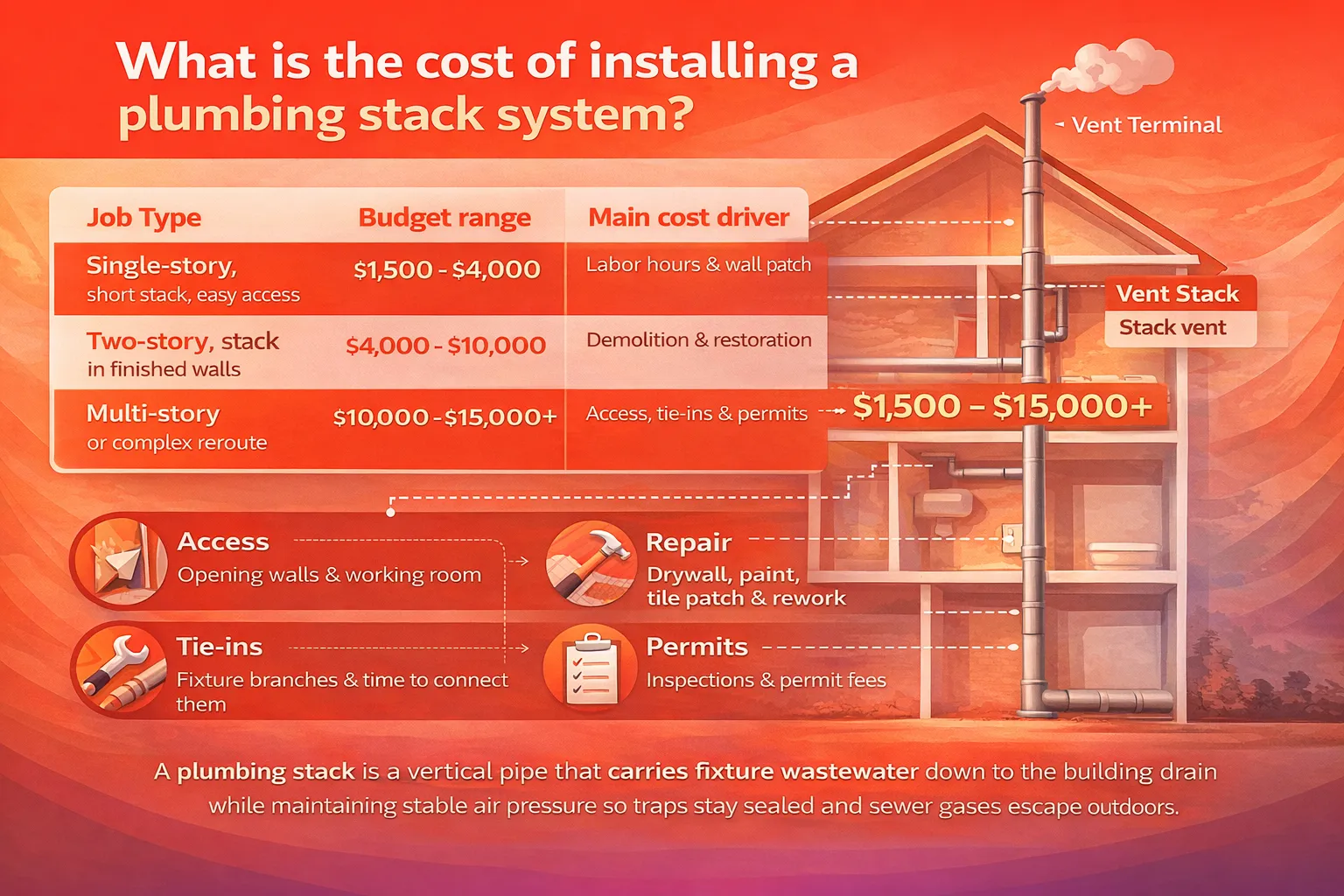
Before the table, here is what it covers: it gives budget ranges by job type, plus the main cost driver for each.
| Job type | Budget range USD | Main cost driver |
|---|---|---|
| Single-story, short stack, easy access | ~1,500 to 4,000 | Labor hours and wall patch |
| Two-story, stack in finished walls | ~4,000 to 10,000 | Demolition and restoration |
| Multi-story or complex reroute | ~10,000 to 15,000+ | Access, tie-ins, permits, days of labor Angi |
Comments (0)
Comments are disabled.