
A plumbing riser is a vertical pipe run that moves water, wastewater, or vent air between floors. This article defines plumbing risers, lists core functions, explains when a riser makes sense in a building, and separates risers from stacks and sewer risers. It lists common riser types, common nominal sizes, and the sizing factors used in plumbing codes. It ends with a practical build checklist, routine care steps, and repair triggers. Each section answers its heading in the first sentence, then adds detail and data.
What is a Plumbing Riser?
A plumbing riser is a vertical section of piping that distributes supply water upward or carries drainage and vent flow between floors in a building. A riser may serve potable water cold or hot, sanitary drainage DWV, venting, storm drainage, gas, or fire protection, with material and sizing set by the adopted plumbing code and product standards for example, IPC or UPC in the U.S., National Plumbing Code of Canada in Canada, plus ASTM and NSF standards for materials and potable contact.
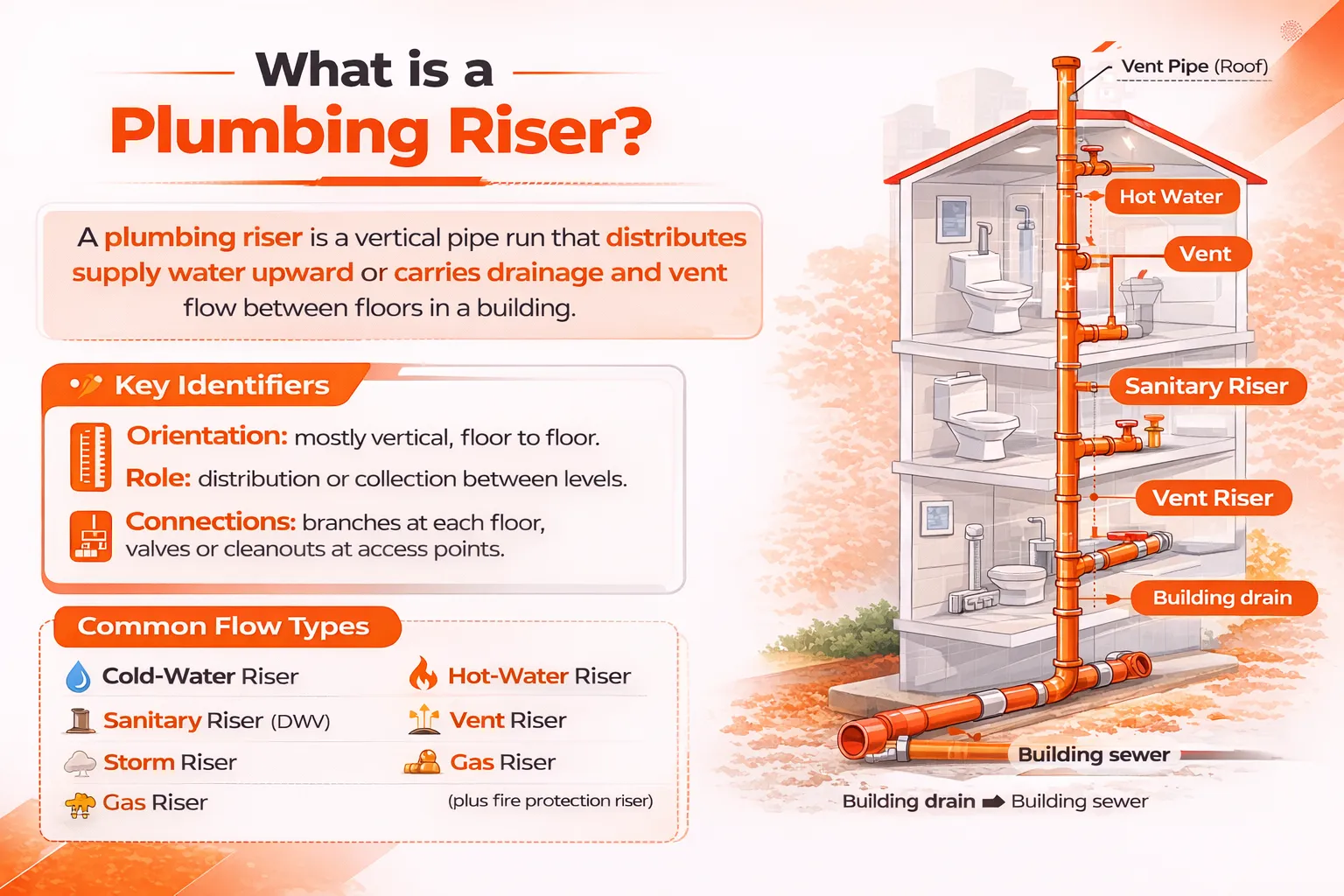
Orientation: mostly vertical, floor to floor.
Role: distribution or collection between levels.
Connections: branches at each floor, valves or cleanouts at access points.
What are the core functions of a plumbing riser?
The core functions of a plumbing riser are to move flow vertically, control pressure zones, and provide a structured path for branches.
Core functions 5
Deliver supply water to upper floors via cold-water and hot-water risers, often with isolation valves per zone.
Return hot water in recirculation loops in larger buildings, which reduces fixture wait time and temperature drop.
Carry wastewater downward through sanitary risers or stacks using gravity. Gravity never misses a shift.
Vent drainage systems through vent risers so traps keep a water seal and drainage stays stable.
Create service access through cleanouts, valves, and floor-by-floor branch points, which reduces demolition during repairs.
Why pressure matters in tall risers
Static pressure from elevation changes by about 0.433 psi per vertical foot of water about 9.8 kPa per meter. That is why taller buildings often use pressure reducing valves, booster pumps, or pressure zones.
When do I need a plumbing riser?
A plumbing riser is used when a building has fixtures on more than one level and the plumbing system needs a vertical path to distribute water, drain wastewater, or vent the system between floors.
Common cases
Two or more stories: bathrooms, kitchens, laundries, and mechanical rooms on upper floors.
Basement plus upper floors: water service enters low, then risers distribute upward.
Multi-unit buildings: vertical “wet walls” stack units for repeatable piping routes.
Long hot-water runs: a hot-water return riser supports recirculation in larger layouts.
Drainage and vent layouts: a vertical sanitary path and a vertical vent path reduce trap siphon risk and stabilize flow.
Code reality check
Many jurisdictions require permits for new risers and major alterations, and many require licensed work for multi-family or commercial systems. That is not tradition, that is enforcement.
What are the types of plumbing risers?
Plumbing risers fall into supply, drainage, vent, storm, and specialty vertical runs.
Main riser types
Cold-water riser CWR: distributes potable cold water upward from the service or booster set.
Hot-water riser HWR: distributes heated water upward from the water heater or central plant.
Hot-water return riser HWRR: returns water to the heater in a recirculation loop.
Sanitary riser: carries wastewater from fixtures down to the building drain.
Vent riser: carries vent air upward and ties into stacks or vent headers.
Storm riser: carries rainwater from roof drains down to storm piping.
Gas riser: carries fuel gas vertically rules differ from water and DWV.
Fire riser: vertical fire protection supply, governed by fire codes and NFPA standards rather than plumbing codes in many areas.
Before the next table: it lists typical flow type, purpose, common materials, and common nominal diameter bands used in North American practice. Final selection comes from code sizing tables, fixture unit counts, and manufacturer limits.
| Riser type | What flows | Primary purpose | Common materials examples | Common nominal diameter band* |
|---|---|---|---|---|
| Cold-water riser | Potable water | Supply distribution | Copper tube, PEX, CPVC, stainless | 3/4 in to 4 in |
| Hot-water riser | Potable water | Hot water distribution | Copper tube, PEX, CPVC, stainless | 3/4 in to 4 in |
| Hot-water return riser | Potable water | Recirculation return | Copper tube, PEX rated for hot | 1/2 in to 2 in |
| Sanitary riser | Wastewater | Fixture drainage to building drain | Cast iron, PVC, ABS | 2 in to 6 in |
| Vent riser | Air | Protect trap seals, stabilize drainage | Cast iron, PVC, ABS | 1 1/2 in to 4 in |
| Storm riser | Rainwater | Roof drainage | Cast iron, PVC, HDPE | 3 in to 10 in |
*Bands describe common nominal sizes seen in the field. Code tables, DFU totals, height limits, and local amendments control the final size.
What is the difference between a riser and a stack?
A riser is any vertical pipe run in a building. A stack is a specific vertical pipe in a drainage system, most often a soil or waste stack that carries discharge from water closets and other fixtures.
Clean definitions
Riser: vertical pipe for supply, drain, vent, storm, gas, or fire.
Stack: vertical main for DWV, with branches per floor.
Before the next table: it compares scope, system type, and the most common inspection points used in practice.
| Topic | Riser | Stack |
|---|---|---|
| Meaning | Any vertical pipe run | Vertical main in DWV |
| Systems | Supply, DWV, vent, storm, gas, fire | DWV soil, waste, vent stacks |
| Flow direction | Up or down | Mostly down for waste, up for vent air |
| Common access point | Isolation valves, access panels | Cleanouts, base of stack, branch fittings |
| Common sizing basis | Flow rate and pressure loss | Drainage fixture units and vent rules |
What is the difference between a riser and a sewer riser?
A sewer riser is a sanitary drainage riser that carries sewage. In many job sites, “sewer riser” refers to the vertical sanitary run that connects fixture branches to the building drain that exits toward the municipal sewer or septic line.
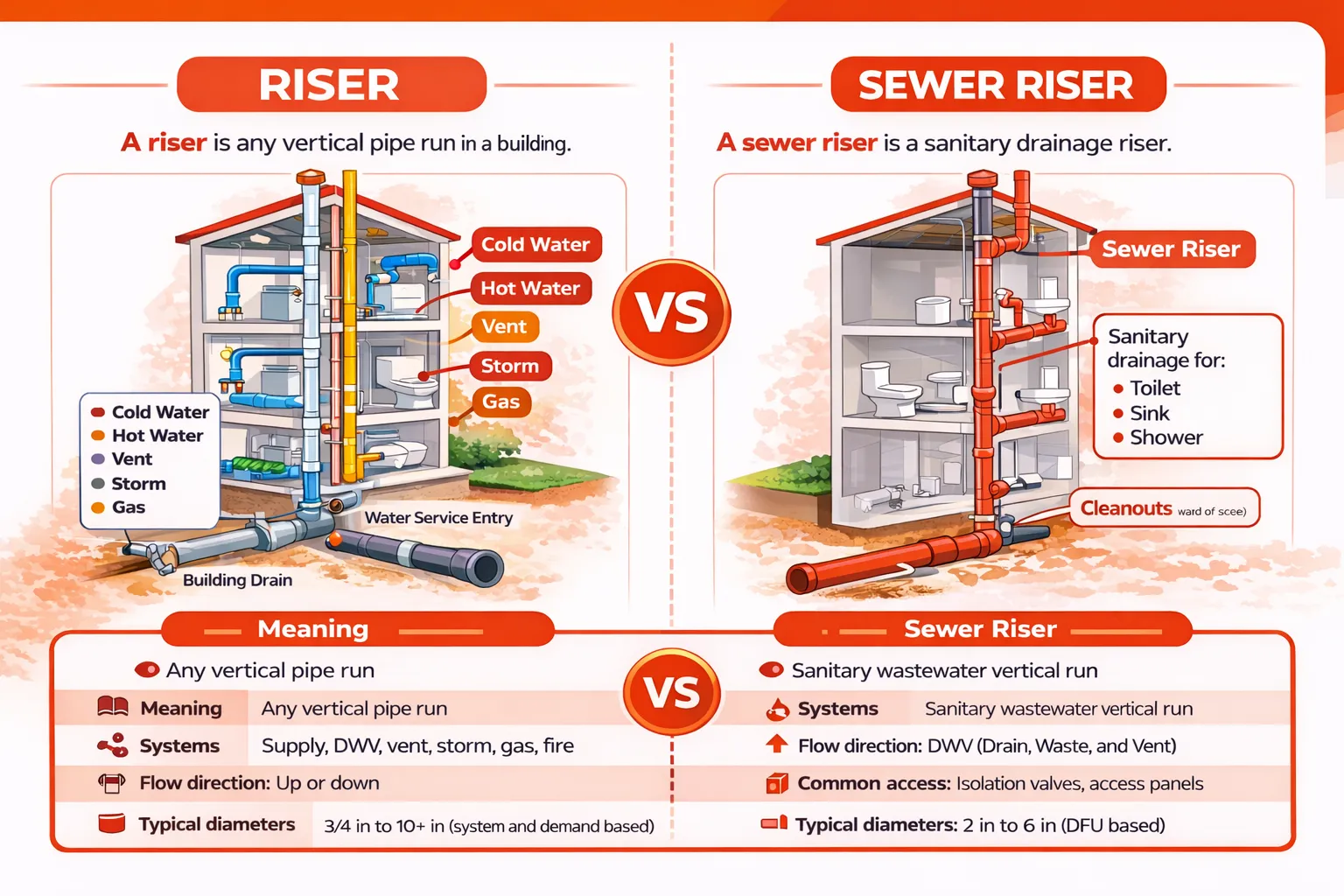
Plumbing riser: broad term for any vertical run.
Sewer riser: narrow term for the sanitary wastewater vertical run.
What are plumbing riser sizes?
Plumbing riser sizes are set by demand load and code tables, not by floor count alone. Supply risers size from flow demand fixture units converted to probable flow and pressure limits. Drainage and vent risers size from drainage fixture units DFU, slope rules, and vent connection limits.
Sizing inputs used by designers and inspectors
Supply load: fixture units, probable flow method, peak use diversity.
Pressure limits: street pressure, booster output, elevation head loss 0.433 psi per foot.
Material limits: allowable pressure rating and temperature rating.
Velocity and noise control: targets differ by material and building type.
Drainage load: DFU totals per branch and per stack.
Vent rules: vent size and tie-in rules per the adopted code.
Before the next table: it lists common nominal sizes and where they show up most often, split by system type.
| Nominal size | Common riser use examples |
|---|---|
| 1/2 in | Hot-water return riser in small loops, short vertical branches |
| 3/4 in | Small supply riser for limited fixture groups |
| 1 in | Typical supply riser in larger single-family or small multi-bath layouts |
| 1 1/4 in to 2 in | Supply risers for higher demand zones, small multi-unit trunks |
| 2 in | Small sanitary riser for limited fixture groups, larger vent riser in some layouts |
| 3 in | Common sanitary stack size in many multi-fixture buildings |
| 4 in | Common soil stack size where water closets dominate the load |
| 6 in and up | Larger sanitary or storm risers in bigger buildings |
How to build your own plumbing riser
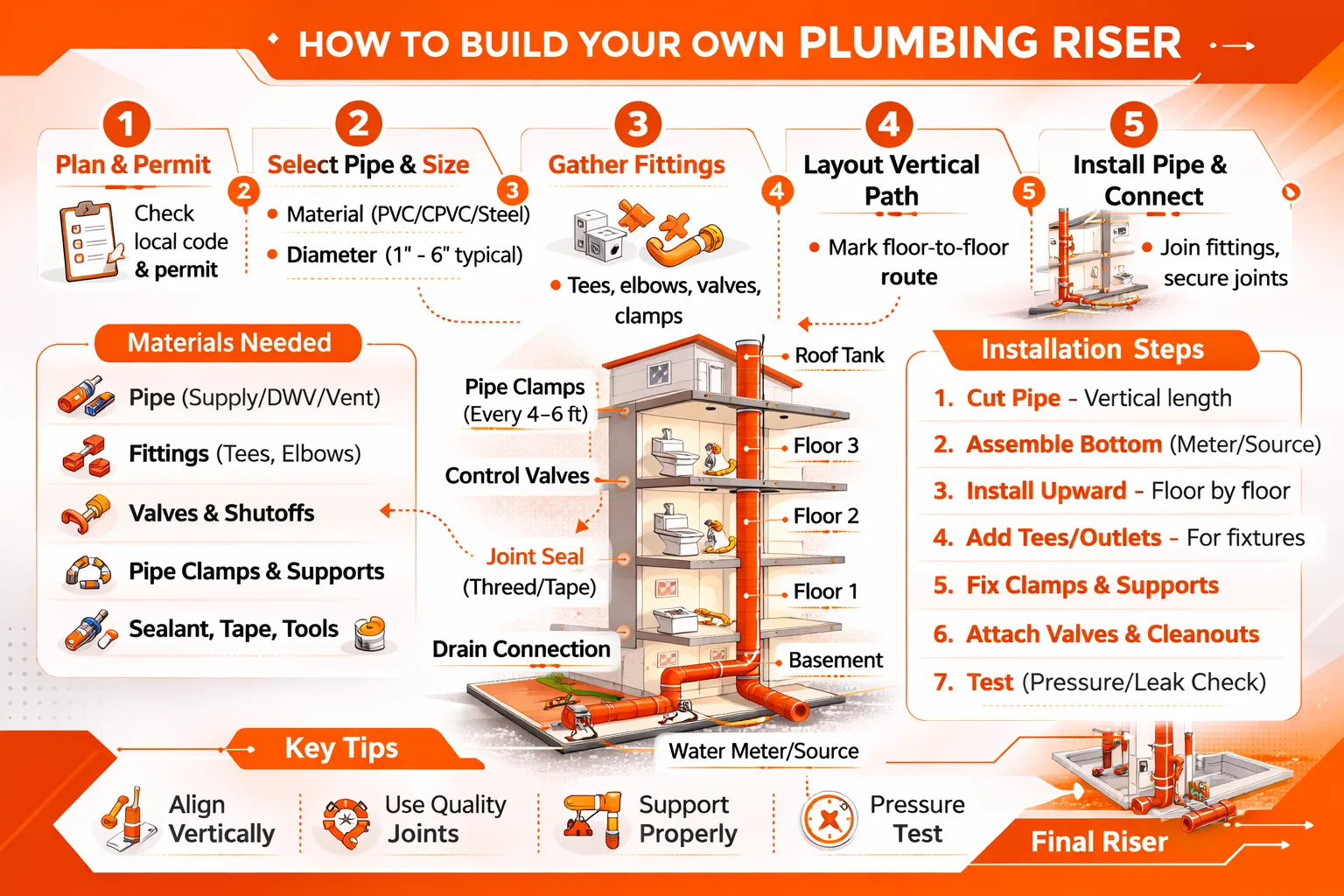
To build your own plumbing riser, plan the vertical route, select code-approved materials, install the riser with proper supports and access points, then test per the adopted code.
Build checklist field sequence
Confirm jurisdiction rules: permit, inspection stages, and licensed scope for the building type.
Define the riser type: cold, hot, return, sanitary, vent, storm, gas. Each type has different rules.
Size the riser: use code tables for fixture units or DFU, then verify available pressure at the highest fixture.
Pick materials and fittings: match the system and local approvals potable water parts commonly reference NSF/ANSI 61 for drinking-water contact.
Lay out the vertical path: align floor penetrations, keep offsets accessible, avoid structural cuts without approval.
Add control and access points:
supply riser: main shutoff, floor or zone isolation valves
DWV stack: cleanouts at base and at required intervals per code
Install supports and fire stopping: support at floor lines and per manufacturer guidance; restore fire rated assemblies where required.
Test the system: water, air, or pressure test method depends on system type and code. Many codes specify a numeric test pressure or test head for the inspection.
Insulate and label: hot water and return lines often get insulation; label valves by zone.
Copper and cast iron remain common in many buildings because repair methods and long-term field data are well known.
Plastic systems gain market share due to labor speed, yet approvals and fire rating rules still control use in many shafts.
How to maintain a plumbing riser?
To maintain a plumbing riser, inspect visible sections, keep access panels usable, verify valve function, and track pressure, temperature, and leak signs by zone.
Routine tasks
Inspect quarterly or semiannually in multi-unit buildings: stains, corrosion, joint creep, loose supports.
Exercise isolation valves at least annually: full close, full open, verify stem and packing.
Check hot-water return balance where present: return temperature at the top zone and pump operation.
Verify drain cleanout access stays clear of storage and finishes.
Record changes: pressure readings at the base and highest floor give a fast way to detect hidden restriction.
When do you need to repair a plumbing riser?
You need to repair a plumbing riser when the riser shows active leakage, repeated joint failure, loss of pressure or flow beyond normal fixture variation, sewer gas odor from drainage paths, or structural decay such as corrosion thinning.
Repair triggers that inspectors treat as real
Visible leak or recurring dampness at a joint, valve, or penetration.
Pinhole leaks in metallic supply risers, often tied to corrosion or water chemistry.
Pressure drop symptoms at upper floors that do not match normal elevation loss.
Recurring blockages on the same vertical line, which often points to internal scaling, offsets, or poor venting.
Odor or trap seal loss tied to vent or sanitary riser defects.
Noise changes such as water hammer events after valve work, which can point to missing arrestors or fast-closing valves in a riser zone.
If you want, I can convert this into your sheet format H1, H2, H3 rows with the corrected headings preserved exactly as questions.
Comments (0)
Comments are disabled.