

A plumber keeps clean water moving in, used water moving out, and fixtures working as intended, using code based methods for sizing, joining, testing, and safety. The work covers homes, shops, towers, and industrial sites, with different tools and job steps for each setting. This guide explains what a plumber does, how residential and commercial work differs, what skills and tools matter, what benefits and hazards come with the trade, how people qualify in Canada, what pay data looks like, how to pick a qualified plumber, and when to call one.
Who Is A Plumber?
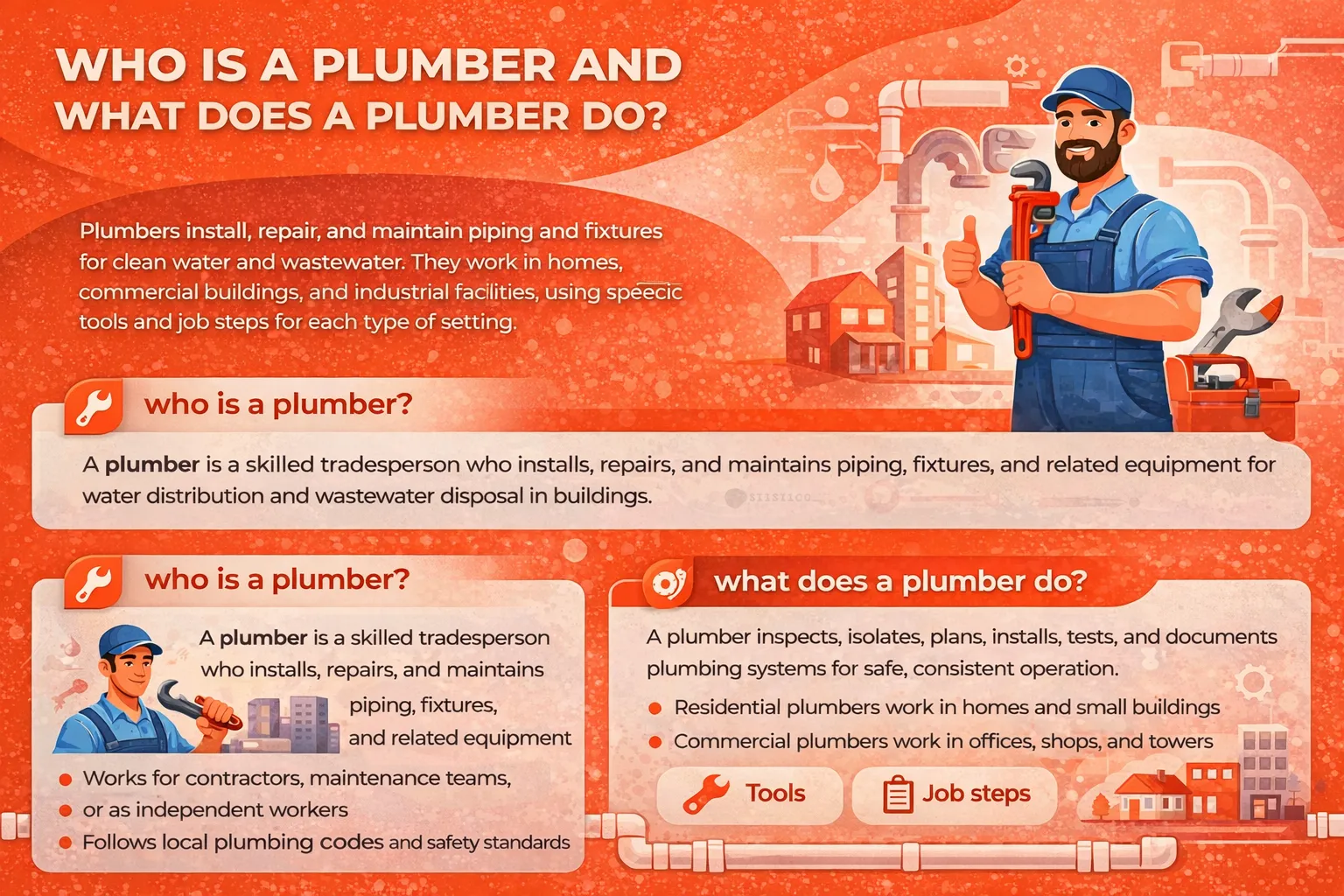
A plumber is a skilled tradesperson who installs, repairs, and maintains piping, fixtures, and related equipment for water distribution and wastewater disposal in buildings. A plumber works for a contractor, a facility maintenance team, a plant, or as an independent worker, depending on the job setting and local rules. A plumber follows the plumbing code used by the local authority, since Canada uses model codes that provinces and territories adopt or adapt.
What Is The Working Of A Plumber?
The working of a plumber is a repeatable job cycle: inspect the system, isolate the area, plan the fix, install or repair components, test for performance, then document and restore service. Job Bank
Common job steps service or new work:
Inspect the fixture, pipe run, drain path, vent path, and shutoffs.
Isolate water or gas supply at the correct valve, then confirm isolation.
Measure pipe size and layout, then select fittings and materials approved by the local code.
Cut and join pipe with the method that matches the material thread, solder, solvent weld, press, clamp.
Support pipe with hangers and fire stopping where required.
Test with the method required for the system, then check fixture function.
Restore service, clean the work area, and note what was changed.
What Does A Residential Plumber Do?
A residential plumber does fixture and piping work inside homes, townhomes, and small residential buildings, with frequent service calls and finished space protection. Statistics Canada
Typical tasks include faucet and toilet repair, water heater work, sump pump service, drain clearing, pipe replacement, and rough in for kitchens or baths.
What Does A Commercial Plumber Do?
A commercial plumber does higher capacity plumbing work in offices, retail, schools, and multi unit buildings, where systems serve many users and inspections are strict. Statistics Canada
Typical tasks include multi fixture rough in, large diameter drainage runs, backflow prevention coordination, mechanical room piping, and scheduled maintenance.
The table below shows practical differences between residential and commercial plumbing work, so the job scope matches the right contractor.
| Attribute | Residential plumber work | Commercial plumber work |
|---|---|---|
| Building type | Single family and small multi unit | Offices, retail, institutions, towers |
| Work pattern | Many short visits, urgent service | Longer projects, scheduled maintenance |
| System scale | Smaller fixture counts | High fixture counts and higher demand |
| Paperwork | Basic service invoice, photos | Permits, inspections, drawings as required |
| Common constraints | Finished surfaces, occupant access | Occupancy rules, shutdown windows |
What Skills Must A Plumber Have?
A plumber must have code literacy, measurement accuracy, safe work habits, and reliable joining and testing technique across materials. Statistics Canada
Core skills that show up on real jobs:
Read codes and drawings local plumbing code, permit notes, manufacturer specs.
Calculate sizing and slope for drainage runs and venting routes.
Select materials that match pressure, temperature, and application.
Join pipe correctly thread, solder, press, solvent weld and verify joint quality.
Test and troubleshoot using pressure testing, flow checks, and fixture diagnostics.
Work safely in confined spaces, at heights, and near electricity.
Skill checks that separate good work from callbacks:
Square cuts and clean prep
Proper support spacing
Correct valve placement and labeling
Cleanout access that stays accessible
What Are The Types Of Plumber?
The types of plumber are role based specializations such as apprentice plumber, journeyperson plumber, maintenance and repair plumber, residential construction plumber, and marine plumber. Statistics Canada
In Canada, these labels often match how an employer posts the job or how a site organizes tasks, while certification and scope stay tied to the local trade rules. Canada
Common role types seen in Canada:
Apprentice plumber works under supervision during training Statistics Canada
Journeyperson plumber qualified worker after training and exam, terms vary by province Canada
Maintenance plumber facility repairs and preventive checks Statistics Canada
Service plumber diagnosis and repair calls in occupied spaces
New construction plumber rough in and finish work on builds
What Are The Most Common Tools That A Plumber Uses?
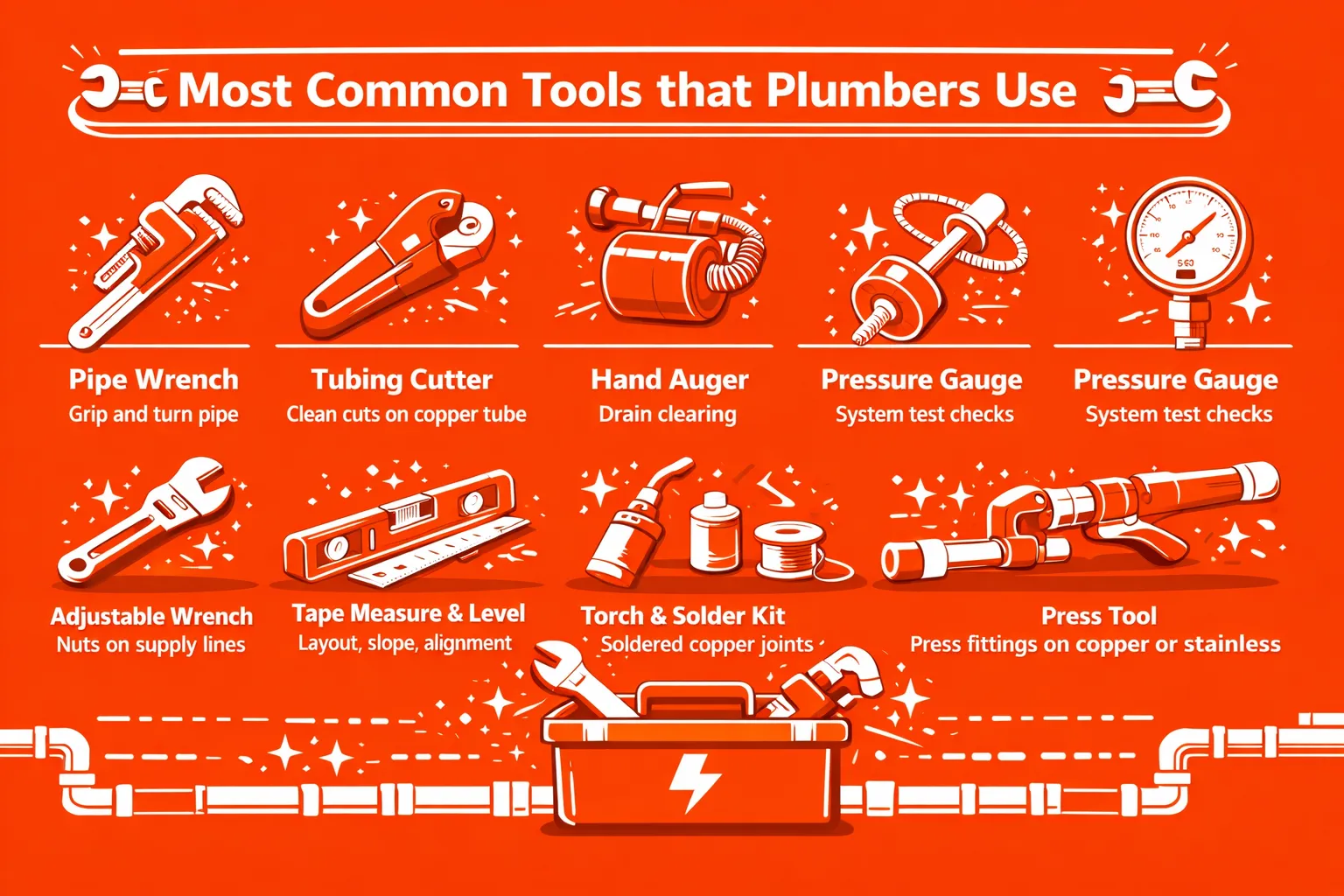
The most common tools that a plumber uses are pipe gripping tools, measuring tools, cutting tools, joining tools, test tools, and drain service tools.
A quick note from the trade: a tape measure and a level end more arguments than a long meeting.
The table below lists common plumber tools, what each tool does, and practical size ranges that show up often in day to day work.
| Tool | Primary use | Common size notes |
|---|---|---|
| Pipe wrench | Grip and turn threaded pipe | 10 in to 18 in lengths are common |
| Adjustable wrench | Nuts on supply lines and valves | Jaw width varies by model |
| Tongue and groove pliers | Grip fittings, trap nuts | 10 in class is common |
| Tubing cutter | Clean cuts on copper tube | Multiple cutter sizes by tube diameter |
| Hacksaw or recip saw | Cuts on mixed materials | Blade choice matches material |
| Tape measure + level | Layout, slope, alignment | 25 ft tape is common |
| Torch + solder kit | Soldered copper joints | Flux, solder, heat control matter |
| Press tool | Press fittings on copper or stainless | Jaws match fitting system |
| Hand auger or machine | Drain clearing | Cable size matches drain size |
| Pressure gauge | System test checks | Range depends on test method |
What Are The Benefits Of Being A Plumber?
The benefits of being a plumber are stable demand tied to buildings, portable skills across regions, and wages that track skilled trade rates. Statistics Canada
In Canada, Job Bank lists a national median wage of $34.15 per hour, with reported values ranging from $20.00 to $46.00 per hour reference period 2022 to 2023, with later page updates. Job Bank
A plumber often works 35 to 40 hours per week, depending on job type and employer. Job Bank
Practical benefits people cite in the trade:
Clear apprenticeship path with paid work time
Work that produces a visible result each day
Options for service work, construction, maintenance, or self employment
What Are The Risks Of Being A Plumber?
The risks of being a plumber are exposure hazards, fire hazards, strain injuries, and jobsite hazards such as confined spaces and falls. CCOHS
CCOHS lists hazards such as lead, sulfur dioxide, asbestos, silica, mould, adhesives, solvents, solder, dusts, and proximity to flammable products in some settings. CCOHS
Risk controls that match the hazard:
Use PPE that fits the task eye protection, gloves, respirator where required.
Ventilate spaces during solvent or solder work.
Use lockout and tag procedures where equipment isolation is required.
Use proper lifting and mechanical aids for heavy fixtures and pipe bundles.
Confirm air quality before confined space entry, where rules apply.
How To Become A Plumber?
To become a plumber, the standard path in Canada is register for an apprenticeship, complete work based training plus in class technical training, then pass the required trade exam, with Red Seal as the interprovincial standard where offered. Canada
A practical step list:
Meet entry rules set by the province or territory trade authority.
Register as an apprentice with an employer sponsor where required.
Complete hours and school blocks required by the jurisdiction.
Pass the certificate exam for journeyperson status where required.
Write the Red Seal exam if the trade and jurisdiction use it, to prove the national standard. Canada
Example of real hour requirements: Skilled Trades Ontario lists 9,000 hours for the plumber apprenticeship program about five years, including 8,280 on the job hours and 720 in school hours. Skilled Trades Ontario
A provincial guidebook example describes a common structure of about 80% work based and 20% classroom time across levels. SkilledTradesBC
What Is The Average Salary Of A Plumber In Canada?
The average salary of a plumber in Canada is most often expressed as an hourly wage, with Job Bank reporting a national median of $34.15 per hour and a national range from $20.00 to $46.00 per hour. Job Bank
If a plumber works 35 to 40 hours per week, the same wage data converts to the annual amounts shown below. Job Bank
The table below converts Job Bank hourly wages into yearly pay at 35 and 40 hours per week, so the numbers stay tied to a stated work week.
| Job Bank wage level Canada | Hourly CAD | Yearly at 35 hr/week CAD | Yearly at 40 hr/week CAD |
|---|---|---|---|
| Low | 20.00 | 36,400 | 41,600 |
| Median | 34.15 | 62,153 | 71,032 |
| High | 46.00 | 83,720 | 95,680 |
How To Find The Right Plumber?
To find the right plumber, use license verification, proof of insurance, clear scope in writing, and code aligned methods that match the job type. Government of Canada Publications
A regulator example: Quebec’s RBQ advises homeowners to use a license holder directory when selecting a contractor. Régie du bâtiment du Québec
Fast checklist that works in any province:
Verify trade status journeyperson, apprentice under supervision, or licensed contractor, per local rules.
Ask for insurance liability, workers coverage where applicable.
Get a written scope with materials, permit plan, and test plan.
Ask about code basis which plumbing code the work follows in that area. Government of Canada Publications
Confirm specialty fit service, new construction, commercial maintenance.
Confirm backflow scope when work touches cross connection control, since many programs reference CSA B64.10 and B64.10.1 for device selection, installation, maintenance, and field testing. Supreme Court of Canada
The table below turns the checklist into a simple decision grid for quotes and callbacks.
| What to verify | What to ask for | What a good answer contains |
|---|---|---|
| Licensing or trade status | “What trade credential applies to this work?” | Specific credential and jurisdiction |
| Insurance | “What coverage applies on site?” | Proof document, valid dates |
| Scope clarity | “What is included and excluded?” | Fixtures, pipe runs, finishes, cleanup |
| Permit plan | “Does this job need a permit?” | Yes or no with local basis |
| Testing | “How do you test the repair?” | Named test method, pass criteria |
| Warranty terms | “What is covered and for how long?” | Written terms, clear limits |
When To Call A Plumber?
When to call a plumber is when a plumbing system shows repeat failure, safety risk, or property damage risk that a basic reset does not fix.
Call a plumber for common warning signs:
Drain backups that return after cleaning
Water pressure that drops across multiple fixtures
Hot water system that fails to keep temperature stable
Sewer odour in occupied areas
Frozen pipe symptoms in winter no flow, bulging pipe, cracking sounds
Moisture marks, drips, or unexplained water meter movement
Any suspected cross connection or backflow issue in a business setting City of Winnipeg
If you need a qualified plumber contact Incanada Plumbing at [email protected].
Comments (0)
Comments are disabled.