

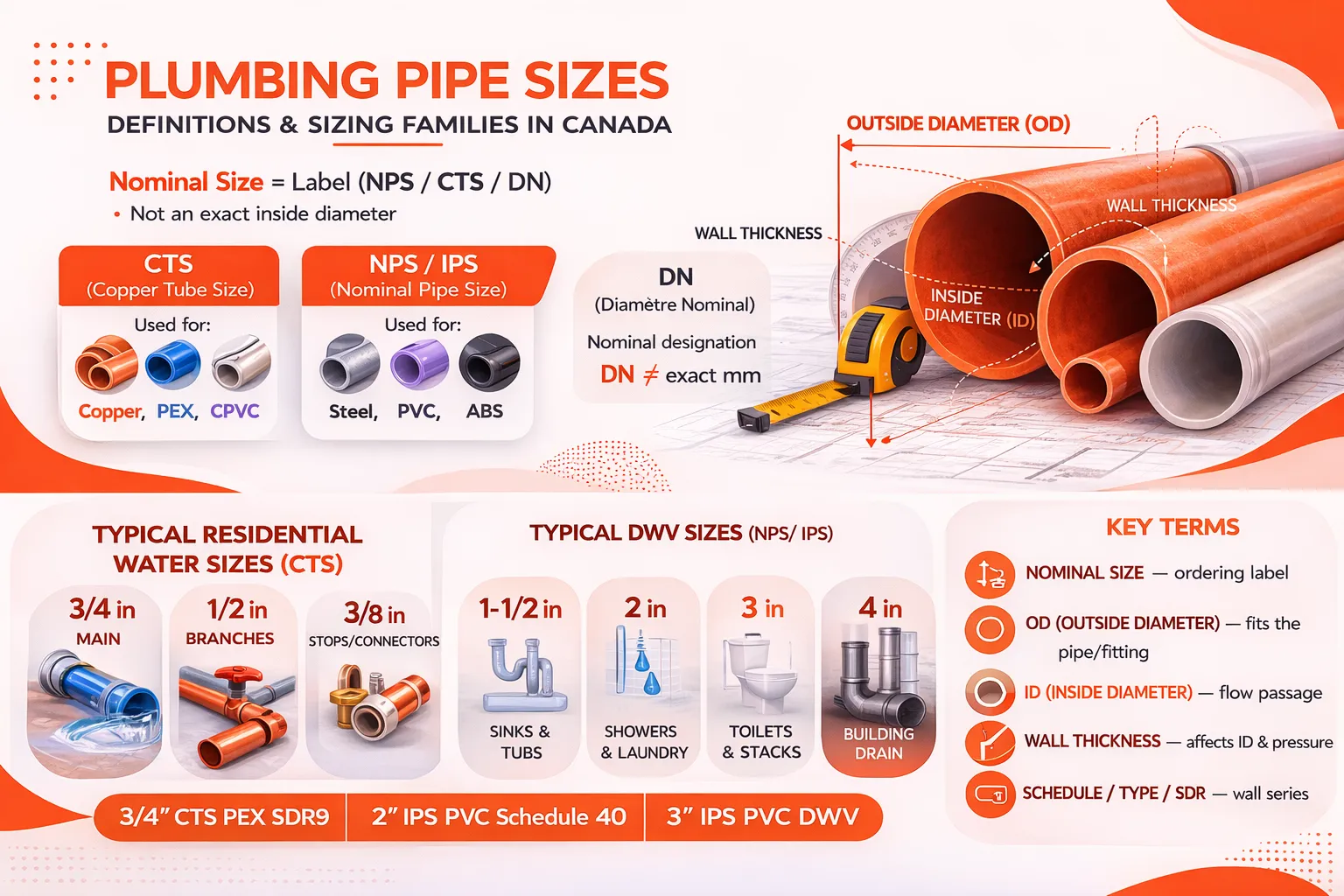
Plumbing pipe size is a nominal label that connects pipe, fittings, valves, and code tables, not a promise of an exact inside diameter. In Canada, most building plumbing uses two main sizing families: CTS Copper Tube Size for copper, PEX, and many CPVC products, and NPS/IPS Nominal Pipe Size / Iron Pipe Size for steel, PVC, ABS, and many threaded systems. Typical residential water distribution uses 1/2 in and 3/4 in pipe, while drain‑waste‑vent DWV systems commonly use 1‑1/2 in, 2 in, 3 in, and 4 in. A pipe size chart is useful because it shows the outside diameter OD and inside diameter ID that change by material and wall thickness Schedule, Type, or SDR.
What are the standard plumbing pipe sizes?
Standard plumbing pipe sizes in Canada are nominal sizes such as 3/8 in, 1/2 in, 3/4 in, 1 in, 1‑1/4 in, 1‑1/2 in, 2 in, 3 in, and 4 in, typically shown in inches and often paired with metric DN diamètre nominal on specifications and drawings used under Canadian code practice.
Canadian supply chains and code references commonly align to North American sizing standards for example, ASME B36.10M for NPS outside diameters, ASTM B88 for copper water tube, ASTM D1785 for PVC pressure pipe dimensions, and ASTM F876/F877 for PEX. Canada also uses CSA standards that adopt or reference these dimension systems for example, CSA B137 series for plastic piping systems.
Standard nominal sizes and typical DN equivalents
DN is a nominal designation, not a measured millimetre diameter.
| Nominal size in | Typical DN | Common building context |
|---|---|---|
| 3/8 | DN10 | fixture supplies / stops often tubing |
| 1/2 | DN15 | fixture branches, small mains |
| 3/4 | DN20 | house mains, hot water distribution |
| 1 | DN25 | larger mains, long runs, higher demand |
| 1‑1/4 | DN32 | small commercial branches, equipment |
| 1‑1/2 | DN40 | equipment, higher‑flow branches, some DWV |
| 2 | DN50 | laundry/shower DWV, commercial branches |
| 3 | DN80 | stacks, toilets, building drains often |
| 4 | DN100 | building drains, building sewers often |
| 6 | DN150 | larger commercial drainage / services |
| 8 | DN200 | large commercial drainage / services |
What is the standard water pipe size in residential plumbing?
Standard residential water pipe size is 1/2 in CTS for most fixture branches and 3/4 in CTS for common mains, with 1 in CTS used when total demand, run length, or pressure drop is higher.
Common sizing pattern in Canadian houses material varies: copper, PEX, CPVC:
3/4 in from meter/service entry to manifold or main distribution path in many homes.
3/4 in to a water heater and major trunks.
1/2 in branches to most fixtures lavatory, kitchen sink, toilet, tub/shower valve.
3/8 in stop/faucet connector tubing is common at fixture shutoffs this is often tubing, not “pipe”.
Flow capacity context domestic water
Pipe sizing relates to allowable velocity and pressure loss. Design guidance summarized in sources such as ASHRAE handbooks and Copper Development Association publications often keeps domestic water velocities around:
~2.4 m/s 8 ft/s for cold water
~1.5 m/s 5 ft/s for hot water
Using copper Type L inside diameters ASTM B88 dimensions, the approximate flow at those velocities is:
| Copper Type L nominal size | Approx ID in | Flow at 8 ft/s US gpm / L·min⁻¹ | Flow at 5 ft/s US gpm / L·min⁻¹ |
|---|---|---|---|
| 1/2 in | 0.545 | ~5.8 gpm / ~22.0 L/min | ~3.6 gpm / ~13.8 L/min |
| 3/4 in | 0.785 | ~12.1 gpm / ~45.7 L/min | ~7.5 gpm / ~28.6 L/min |
| 1 in | 1.025 | ~20.6 gpm / ~77.9 L/min | ~12.9 gpm / ~48.7 L/min |
These values explain why 3/4 in mains and 1/2 in branches cover most residential demand patterns without excessive velocity.
What is the chart of plumbing pipe sizes?
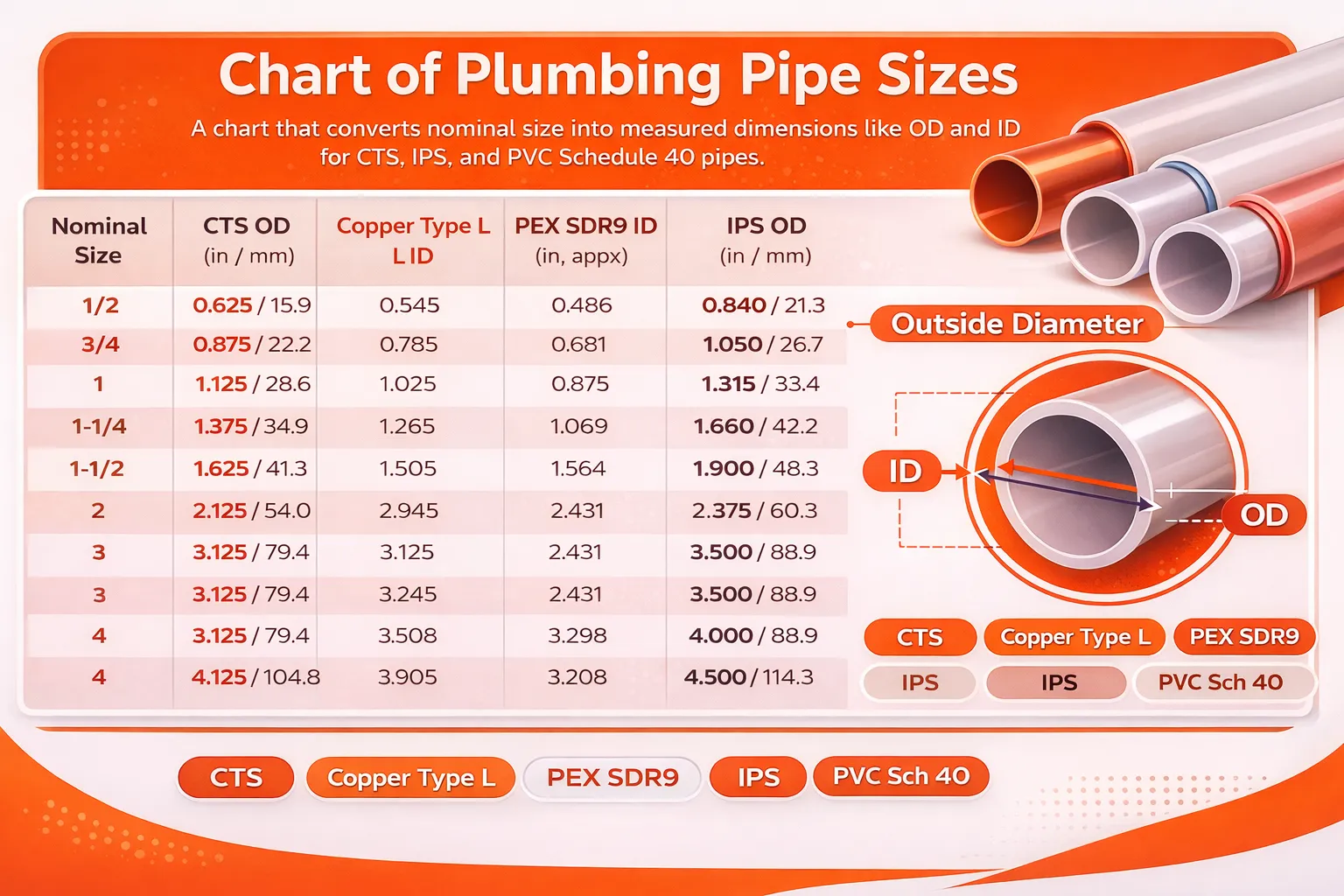
A plumbing pipe size chart is a table that converts nominal size into measured dimensions—typically OD, wall thickness, and ID—for each sizing system CTS vs NPS/IPS and each standard Schedule, Type, SDR.
The key reason charts matter is that the same nominal size can have different ODs depending on the sizing family:
1/2 in CTS copper/PEX/CPVC has OD 0.625 in 15.9 mm
1/2 in NPS/IPS PVC/steel has OD 0.840 in 21.3 mm
Plumbing pipe size chart common building sizes
The table below uses widely adopted standards for dimensions:
NPS/IPS OD convention: ASME B36.10M
Copper water tube: ASTM B88 Type L
PVC Schedule 40 dimensions: ASTM D1785
PEX ID shown as SDR‑based approximation for SDR 9 common PEX sizing approach under ASTM F876
| Nominal size | CTS OD in / mm | Copper Type L ID in | PEX SDR9 ID in, approx | IPS OD in / mm | PVC Sch 40 ID in, approx |
|---|---|---|---|---|---|
| 1/2 | 0.625 / 15.9 | 0.545 | 0.486 | 0.840 / 21.3 | 0.622 |
| 3/4 | 0.875 / 22.2 | 0.785 | 0.681 | 1.050 / 26.7 | 0.824 |
| 1 | 1.125 / 28.6 | 1.025 | 0.875 | 1.315 / 33.4 | 1.049 |
| 1‑1/4 | 1.375 / 34.9 | 1.265 | 1.069 | 1.660 / 42.2 | 1.380 |
| 1‑1/2 | 1.625 / 41.3 | 1.505 | 1.264 | 1.900 / 48.3 | 1.610 |
| 2 | 2.125 / 54.0 | 1.985 | 1.653 | 2.375 / 60.3 | 2.067 |
| 3 | 3.125 / 79.4 | 2.945 | 2.431 | 3.500 / 88.9 | 3.068 |
| 4 | 4.125 / 104.8 | 3.905 | 3.208 | 4.500 / 114.3 | 4.026 |
Interpretation rule: fittings match nominal size and sizing system, not the measured ID. A “1/2 in” PEX fitting matches 1/2 in CTS OD, not 1/2 in IPS OD.
What are the common plumbing sizes used in residential buildings in Canada?
Common plumbing sizes used in residential buildings in Canada are 1/2 in and 3/4 in for water distribution and 1‑1/2 in, 2 in, 3 in, and 4 in for DWV drainage and venting.
Common residential water supply sizes CTS family: copper, PEX, CPVC
3/4 in: service entry to main distribution, water heater feeds, trunk lines.
1/2 in: fixture branches to lavatory, kitchen sink, toilet, tub/shower valve, dishwasher feed material and local practice vary.
3/8 in: fixture connector supplies at shutoff valves often braided connectors or small tubing.
Common residential DWV sizes often PVC/ABS, IPS family
1‑1/4 in to 1‑1/2 in: many sink/lavatory trap arms and branch drains material and local minimums vary.
2 in: showers, tubs often, laundry standpipes, branch drains that aggregate multiple fixtures.
3 in: toilets and soil stacks in many homes.
4 in: building drain/building sewer in many detached home layouts and where longer runs or more fixtures exist.
Common residential vent sizes
1‑1/2 in to 2 in venting is common for individual/branch venting arrangements.
3 in to 4 in roof penetrations occur where vent stacks combine with soil stacks.
What are the common plumbing sizes used in commercial buildings in Canada?
Common plumbing sizes used in commercial buildings in Canada are 1 in to 4 in for domestic water distribution and 2 in to 8 in or larger for DWV and storm drainage, depending on fixture count, floor area, and stack loading.
Commercial patterns that drive larger sizes:
Higher fixture unit counts per branch and per stack.
Longer distribution runs from mechanical rooms to tenant spaces.
Multiple washrooms and higher simultaneous demand.
Larger drainage stacks and building drains to manage peak discharge.
Typical commercial size ranges by subsystem:
Domestic cold/hot distribution mains: 1 in, 1‑1/4 in, 1‑1/2 in, 2 in, 3 in larger in high‑rise cores.
Tenant/zone branches: 3/4 in to 2 in.
DWV branches: 2 in, 3 in, 4 in.
Soil/waste stacks: 3 in, 4 in, 6 in larger when stack loading is high.
Building drains / building sewers: 4 in, 6 in, 8 in, 10 in based on calculated load and site servicing.
Commercial sizing is typically calculated using code fixture‑unit methods National Plumbing Code framework and local amendments and hydraulic sizing approaches used in engineering practice for example, methods summarized in ASHRAE and plumbing engineering handbooks.
What are the standard plumbing pipe size dimensions?
Standard plumbing pipe size dimensions are outside diameter OD, inside diameter ID, wall thickness, and length, with wall thickness controlled by Schedule PVC/steel, Type copper, or SDR many plastics.
Core dimension terms used on pipe charts
Nominal size NPS / CTS / DN: the label used for ordering and matching fittings.
Outside diameter OD: the measured external diameter; OD drives fitting compatibility.
Inside diameter ID: the internal opening; ID drives flow capacity and friction loss.
Wall thickness: the material thickness; wall thickness drives pressure rating and changes ID.
Schedule: a wall‑thickness series for NPS/IPS pipe e.g., Sch 40 vs Sch 80.
Type copper: copper tube wall series e.g., Type K, L, M; Type K is thicker than Type L, Type L is thicker than Type M.
SDR Standard Dimension Ratio: OD ÷ wall thickness. Example: SDR 9 implies wall thickness ≈ OD/9.
What changes and what stays fixed
NPS/IPS systems: OD stays fixed for a given NPS; ID changes with Schedule. This convention comes from ASME pipe dimension standards such as ASME B36.10M.
CTS systems: OD stays fixed for a given CTS nominal size; ID changes with copper Type or plastic SDR. Copper tube dimensions are defined in standards such as ASTM B88.
DN: DN is a nominal descriptor ISO 6708 uses DN as a designation system. DN does not guarantee an exact millimetre measurement.
Simple dimension calculations used in charts
ID = OD − 2 × wall thickness
OD from circumference measurement: OD = circumference ÷ π
SDR wall thickness: wall thickness = OD ÷ SDR
These calculations are the reason two “1/2 in” pipes can have different measured ODs and IDs when the sizing families differ.
How do you identify pipe sizes?
To Identify pipe sizes, measure the outside diameter, confirm the sizing family CTS vs IPS, and then match the measurement to a nominal size chart using the pipe’s material markings.
Identification steps field method
Read pipe markings: look for material and standard markings such as ASTM/CSA identifiers, “SCH 40”, “Type L”, “PEX SDR9”, or pressure/temperature ratings.
Measure OD with a caliper for best accuracy; measure to the nearest 0.5 mm or 1/64 in.
Match OD to sizing family:
CTS sizes copper/PEX/CPVC have smaller ODs for the same nominal size.
IPS sizes steel/PVC/ABS have larger ODs for the same nominal size.
Confirm by fitting test: a known fitting CTS or IPS confirms the family because OD match is decisive.
Use ID only as a secondary check because wall thickness changes ID.
Quick OD-to-nominal reference common sizes
| Measured OD in | Measured OD mm | Nominal size & sizing family |
|---|---|---|
| ~0.625 | ~15.9 | 1/2 in CTS copper/PEX/CPVC |
| ~0.840 | ~21.3 | 1/2 in IPS/NPS PVC/steel/ABS |
| ~0.875 | ~22.2 | 3/4 in CTS |
| ~1.050 | ~26.7 | 3/4 in IPS/NPS |
| ~1.125 | ~28.6 | 1 in CTS |
| ~1.315 | ~33.4 | 1 in IPS/NPS |
| ~1.625 | ~41.3 | 1‑1/2 in CTS |
| ~1.900 | ~48.3 | 1‑1/2 in IPS/NPS |
| ~2.125 | ~54.0 | 2 in CTS |
| ~2.375 | ~60.3 | 2 in IPS/NPS |
This OD check prevents the most common purchasing error: buying 1/2 in IPS fittings for 1/2 in PEX/copper, or the reverse.
How to buy the right pipe size for your needs?
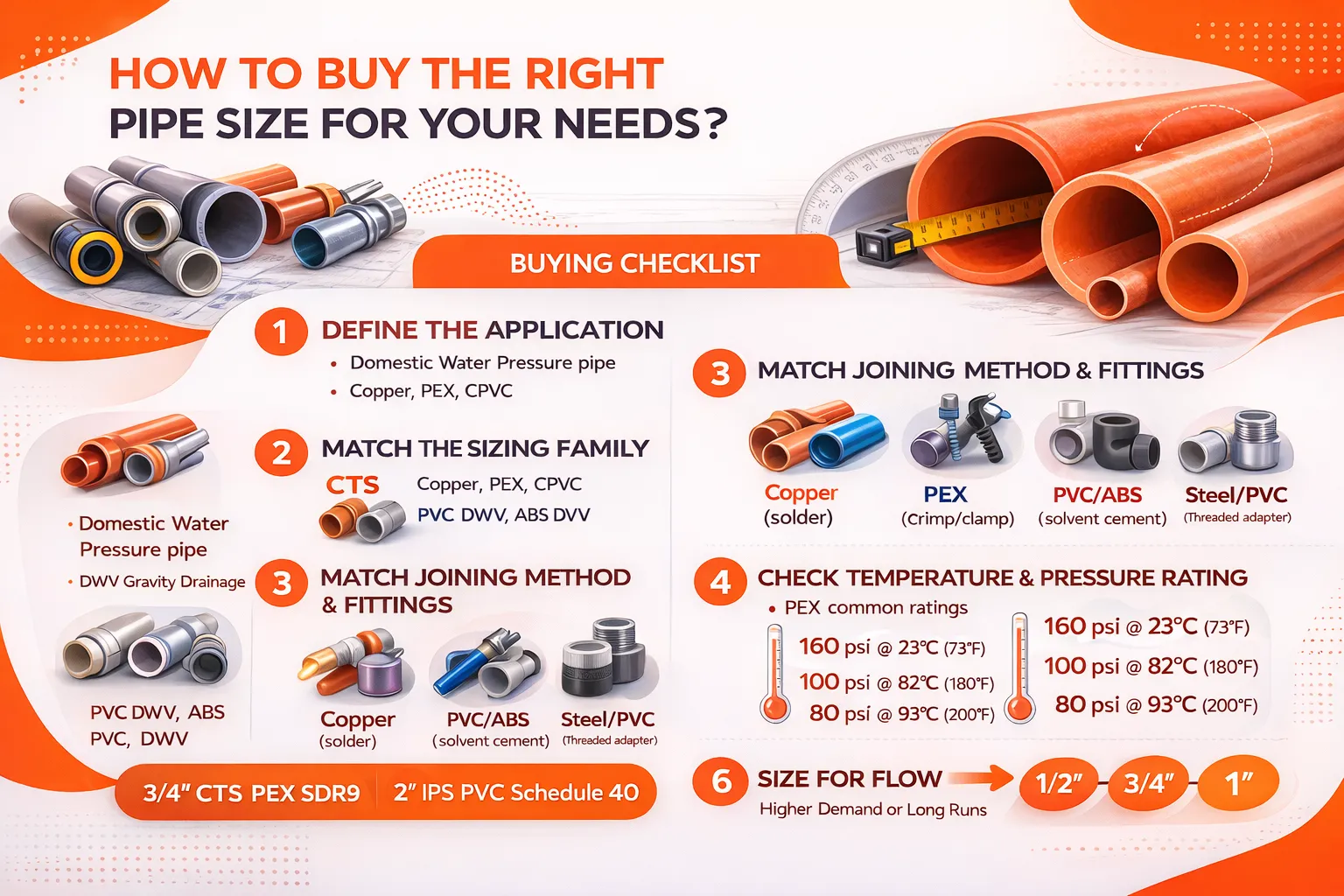
To buy the right pipe size for your needs, select the system type water supply vs DWV, match the sizing family CTS vs IPS, and choose a diameter that meets flow and code-based minimums without excessive pressure loss.
Buying checklist practical and code-aligned
Define the application
Domestic water pressure pipe: copper, PEX, CPVC, PVC limited indoor potable use varies by jurisdiction, stainless, etc.
DWV gravity drainage: PVC DWV, ABS DWV, cast iron, etc.
Match the sizing family
CTS: copper tube, PEX, many CPVC products.
IPS/NPS: PVC Sch 40/80 pressure pipe, ABS/PVC DWV by OD convention, steel pipe.
Match joining method and fittings
Copper: solder/braze, press-fit, compression.
PEX: crimp, clamp, expansion system-specific.
PVC/ABS: solvent cement DWV or pressure-rated formulations differ.
Threaded steel/PVC adapters: use correct thread standards and transition fittings.
Check temperature and pressure rating
PEX commonly uses ratings summarized in ASTM F876 practice: 160 psi @ 23°C 73°F, 100 psi @ 82°C 180°F, 80 psi @ 93°C 200°F for many PEX products product markings confirm.
Check potable water certifications
In Canada, potable water components commonly reference NSF/ANSI/CAN 61 and related system standards for drinking-water contact; product markings and certification listings confirm compliance.
Size for flow
Higher demand or long runs push mains from 1/2 in → 3/4 in → 1 in in many residential layouts.
Branches to single fixtures often remain 1/2 in because fixture flow rates are low compared with trunk demand.
Quick buying guide by use-case common Canadian practice
Single fixture branch sink, toilet, tub/shower valve: 1/2 in CTS.
Whole-house main in a typical detached home: 3/4 in CTS; 1 in CTS where demand/length is higher.
DWV for sinks/tubs: commonly 1‑1/2 in.
DWV for showers/laundry: commonly 2 in.
Toilet drain and main soil stack: commonly 3 in.
Building drain / sewer connection: commonly 4 in many detached homes.
Buying accuracy improves when the purchase list includes nominal size + sizing family + material + wall series, such as:
“3/4 in CTS PEX SDR9”
“2 in IPS PVC Schedule 40 pressure pipe”
“3 in IPS PVC DWV”
What is the size for water waste pipe?
Water waste pipe size in buildings is commonly 1‑1/2 in to 4 in in residential DWV systems, with 2 in, 3 in, and 4 in dominating the highest-flow fixture connections and building drains.
Common DWV water-waste sizes by fixture group typical installed sizes
| Fixture / drain function | Common waste pipe size in | Context note |
|---|---|---|
| Lavatory / bathroom sink trap arm | 1‑1/4 to 1‑1/2 | trap assemblies often 1‑1/4 or 1‑1/2 |
| Kitchen sink | 1‑1/2 | grease/solids handling benefits from larger size |
| Bathtub | 1‑1/2 | local practice varies with fixture outlet and trap |
| Shower | 2 | many shower drains and traps are 2 in |
| Laundry standpipe | 2 | high discharge rate compared with a lavatory |
| Toilet water closet | 3 | most residential toilet outlets and flanges align to 3 in |
| Soil stack / main stack | 3 to 4 | depends on number of fixtures and layout |
| Building drain / building sewer | 4 | common service size for detached homes; larger for bigger loads |
Commercial water-waste pipe sizing expands upward because fixture counts and stack loading increase; 4 in to 10 in is common across many commercial drainage and building sewer contexts.
Comments (0)
Comments are disabled.