
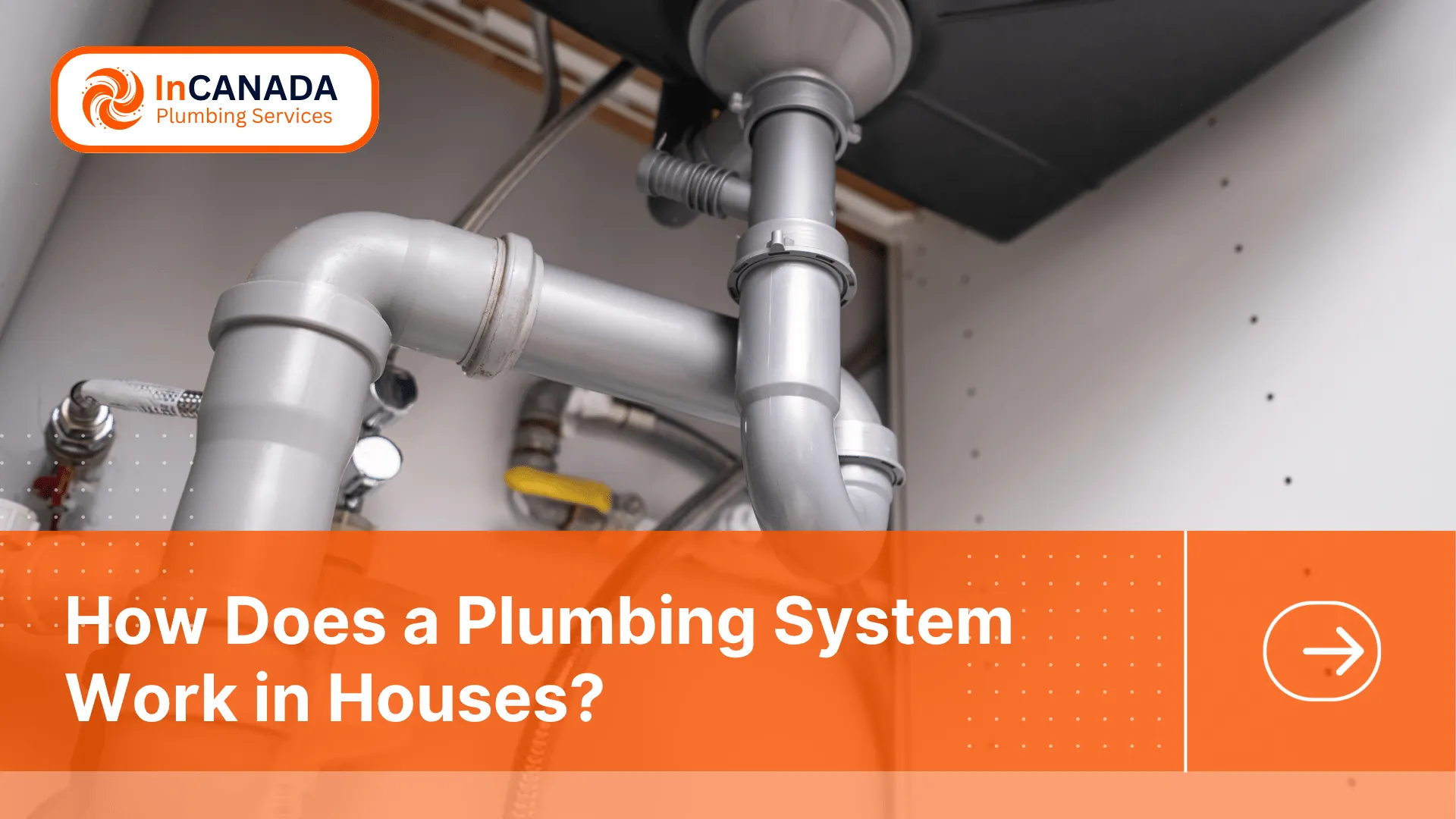
A house plumbing system works by using water pressure to deliver potable water to fixtures and gravity to remove wastewater through drains, traps, vents, and a building sewer.
In Canadian houses, plumbing connects 4 working systems: water supply, hot water distribution, drain-waste-vent piping, and fixture protection. The National Plumbing Code of Canada defines plumbing around safe potable water, wastewater removal, water-use efficiency, and protection from sewage or water damage. Statistics Canada reported 223 litres per person per day as Canada’s average residential water use in 2021, so a working house plumbing system manages hundreds of litres daily in a normal household.
What is a house plumbing system?
A house plumbing system is a connected pipe, valve, fixture, drain, and vent network that brings clean water in and sends used water out.
A Canadian residential plumbing system usually has 4 core parts.
Water supply and distribution system: potable water enters from a municipal watermain, private well, cistern, or pressure system.
Drainage system: wastewater leaves fixtures through fixture drains, branch drains, stacks, building drains, and building sewers.
Venting system: vent pipes connect drainage pipes to open air and protect trap seals.
Fixtures and appliances: sinks, toilets, bathtubs, showers, laundry tubs, washing machines, dishwashers, and water heaters receive or discharge water.
These 4 parts work as one system. Potable water stays under pressure. Wastewater flows by gravity. Vent air balances the drain system. Traps hold water seals that block sewer gas.
How does clean water enter a house?
Clean water enters a house through a water service pipe connected to a municipal watermain, private well, cistern, or other approved supply.
The water service pipe usually enters through the basement wall, mechanical room, crawlspace, or slab entry point. The first interior components often include a main shut-off valve, water meter, pressure-reducing valve where required, backflow protection where required, and cold-water distribution piping.
A common residential sequence is:
Municipal watermain or private well
Service pipe
Main shut-off valve
Water meter or pressure tank
Pressure control device
Cold-water distribution pipes
Water heater branch
Hot-water distribution pipes
Fixture supply stops
Faucets, toilets, showers, appliances, and hose bibbs
Municipal water arrives under pressure from the public distribution system. A private well uses a pump and pressure tank. Both systems need pressure, shut-off control, and cross-connection protection to keep potable water isolated from contamination.
What does the main water shut-off valve do?
The main water shut-off valve stops all incoming potable water before water reaches the house distribution pipes.
The main shut-off valve controls emergency water isolation. A closed main valve stops water flow during burst pipes, fixture replacement, water heater service, frozen-pipe repair, or supply-line failure. A house also has smaller stop valves at toilets, sinks, dishwashers, washing machines, and exterior taps.
A practical residential shut-off map has 5 control points.
Main shut-off valve: isolates the whole house.
Water heater shut-off valve: isolates cold water entering the water heater.
Fixture stop valves: isolate sinks, toilets, and some appliances.
Exterior hose shut-off valve: isolates outdoor hose bibbs in winter.
Branch shut-off valve: isolates a zone, bathroom, laundry room, or kitchen where installed.
Shut-off valves reduce leak volume because water damage depends on flow rate and time. A 1-hour leak causes less damage when the correct valve closes in the first few minutes.
How does water pressure move water through house pipes?
Water pressure moves water through house pipes by pushing potable water from the supply line toward lower-resistance open fixtures.
When a faucet opens, pressure drops at that fixture. Water moves from higher pressure in the service line through smaller branch pipes to the open outlet. The same pressure supplies toilets, showers, tubs, washing machines, dishwashers, ice makers, and hose bibbs.
Pressure must stay controlled. Ontario code language uses 550 kPa as a fixture static-pressure threshold for pressure reduction. High pressure increases stress on valves, washers, supply hoses, toilet fill valves, appliance solenoids, water heater components, and pipe joints. Low pressure reduces shower flow, toilet refill speed, washing machine fill rate, and simultaneous fixture performance.
A pressure-reducing valve performs 3 functions.
Reduces incoming pressure when municipal pressure is too high.
Stabilizes fixture pressure when pressure fluctuates.
Protects plumbing components from excess static pressure.
A pressure gauge test at a laundry tap, hose bibb, or water heater drain gives a direct pressure reading. A pressure reading changes between static pressure and flowing pressure because pipe friction increases when water moves.
How does cold water become hot water?
Cold water becomes hot water when the cold-water line feeds a water heater that raises water temperature and sends heated water through hot-water distribution pipes.
A house water heater usually connects to 4 plumbing components.
Cold-water inlet: brings potable water into the tank or heat exchanger.
Hot-water outlet: sends heated water to faucets, showers, tubs, and appliances.
Temperature and pressure relief valve: releases water during unsafe temperature or pressure conditions.
Drain valve: allows tank draining, sediment flushing, and service access.
Canadian houses use several water-heating systems, including tank water heaters, tankless water heaters, indirect water heaters, heat pump water heaters, and combination boiler systems. The plumbing principle stays the same: cold water enters, heat transfers, hot water exits, and pressure moves hot water to fixtures.
Hot water distribution has 4 performance limits.
Distance: longer pipe runs increase wait time at fixtures.
Pipe diameter: larger pipes hold more standing water.
Heat loss: uninsulated hot-water pipes lose heat faster.
Simultaneous demand: showers, laundry, and dishwashers divide available hot-water flow.
A recirculation line reduces hot-water wait time in some houses. A mixing valve blends hot and cold water to control outlet temperature where installed.
How does water reach faucets, toilets, showers, and appliances?
Water reaches fixtures through branch supply pipes that split from main cold-water and hot-water distribution lines.
Cold water serves toilets, exterior hose bibbs, ice makers, washing machines, dishwashers, tubs, showers, lavatories, and kitchen faucets. Hot water serves lavatories, kitchen faucets, showers, tubs, laundry fixtures, dishwashers, and some washing machine cycles.
A typical fixture connection has 5 parts.
Branch pipe: carries water from the main line to the room.
Fixture stop valve: isolates one fixture.
Supply tube: connects the stop valve to the fixture.
Fixture valve or cartridge: controls flow and temperature.
Aerator, shower head, fill valve, or appliance valve: delivers water at the outlet.
Common potable water pipe materials include copper, PEX, CPVC, and approved plastic or composite systems. The National Plumbing Code of Canada 2020 added options such as PE-RT tube and cellular core PVC pipe in specific code contexts. CSA Group tests and certifies pressure and non-pressure pipe and fitting products for plumbing applications.
How does wastewater leave a house?
Wastewater leaves a house through gravity drainage pipes that carry used water from fixtures to a municipal sewer, septic tank, or holding tank.
The drainage path has 7 connected parts.
Fixture outlet: the opening at the sink, toilet, tub, shower, or appliance.
Trap: the water-seal fitting under or near the fixture.
Fixture drain: the pipe leaving the trapped fixture.
Branch drain: the horizontal pipe receiving one or more fixture drains.
Soil stack or waste stack: the vertical pipe carrying toilet waste or greywater.
Building drain: the lowest horizontal drainage pipe inside the building.
Building sewer: the pipe from the building drain to the public sewer or private sewage system.
Toilets discharge blackwater. Sinks, showers, tubs, laundry, and dishwashers discharge greywater. Both connect to sanitary drainage unless a local code-approved non-potable or reuse system separates specific water streams.
Drainage pipes need correct diameter, slope, trap placement, venting, cleanout access, and connection order. Poor drainage design causes slow drains, siphoned traps, gurgling, sewer odour, recurring clogs, and basement backups.
How does the drain-waste-vent system work?
The drain-waste-vent system works by moving wastewater downward while vent pipes move air into the drainage system and protect trap seals.
The drain-waste-vent system is called DWV because 3 functions happen together.
Drain: carries wastewater from fixtures.
Waste: carries greywater and sewage to disposal.
Vent: admits air and releases sewer gas above the roof.
When water flows down a pipe, moving water displaces air. Without vent air, negative pressure can pull water out of traps. Without trap water, sewer gas can enter the house. Vent pipes connect downstream of traps and terminate outdoors, usually through the roof.
A balanced DWV system prevents 4 common failures.
Siphonage: flowing water pulls the trap seal out.
Back pressure: air pressure pushes sewer gas through the trap.
Slow drainage: trapped air reduces drain flow.
Gurgling: air enters through fixture traps instead of vent pipes.
The DWV system is the part of house plumbing that explains why drains, traps, vents, and roof pipes belong to the same system.
Why do traps hold water?
Traps hold water because a trap seal blocks sewer gas while still allowing wastewater to flow through the drain.
A trap is usually a P-shaped or U-shaped fitting under a sink, tub, shower, floor drain, laundry standpipe, or appliance drain. The trap holds a small volume of water after each fixture use. That water becomes the seal between indoor air and the drainage system.
A trap seal depends on 4 conditions.
Water remains in the trap.
Vent air prevents siphonage.
Drain flow does not create excessive pressure.
The fixture receives periodic water use.
Unused floor drains, basement drains, guest bathrooms, and laundry drains can lose trap water by evaporation. A dry trap often creates sewer odour because the water seal no longer blocks gas.
Why do plumbing vents go through the roof?
Plumbing vents go through the roof because vent pipes release sewer gas outdoors and bring air into the drainage system above occupied spaces.
A roof vent is not a water pipe. A roof vent is an air pipe connected to the drainage system. The roof termination keeps sewer gas away from windows, doors, soffits, air intakes, and living areas.
Vents support 3 drainage functions.
Equalize air pressure inside the drain system.
Protect trap seals from siphonage and back pressure.
Improve gravity flow by allowing air behind moving wastewater.
A blocked vent can create slow drains, bubbling toilets, gurgling sinks, sewer odour, and repeated trap seal loss. Snow, leaves, nests, roof debris, and frost can restrict vent openings in Canadian climates.
What are typical pipe sizes in a Canadian house?
Typical house plumbing pipe sizes depend on fixture load, pipe material, local code, developed length, pressure, and drainage design.
The table below shows common residential guide values used in Canadian municipal homeowner plumbing guidance. Local code, permit drawings, and inspection authority control final sizing.
| Plumbing part | Common residential size | Main function |
|---|---|---|
| Water service entering dwelling | 3/4 inch | Supplies potable water from outside source |
| Hot and cold distribution pipes | 1/2 inch minimum | Feeds fixtures and appliances |
| Building drain | 4 inch minimum | Receives multiple drainage branches |
| Toilet drain | 3 inch minimum | Carries toilet discharge |
| Floor drain | 2 inch minimum | Receives floor-level drainage |
| Washing machine drain | 2 inch minimum | Handles washer discharge volume |
| Kitchen sink drain | 1-1/2 inch minimum | Carries kitchen wastewater |
| Bathtub drain | 1-1/2 inch minimum | Carries tub wastewater |
| Shower stall drain | 1-1/2 inch minimum | Carries shower wastewater |
| Wash basin drain | 1-1/4 inch minimum | Carries lavatory wastewater |
| Main stack vent through roof | 3 inch minimum | Vents the drainage stack |
| Other dwelling vent pipes | 1-1/2 inch minimum | Protects trap seals |
Pipe size is not selected by appearance. Pipe size is selected by hydraulic load, fixture units, fixture type, pipe slope, developed length, and code tables.
How do sewer and septic plumbing connections differ?
Sewer and septic plumbing connections differ because a sewer connection sends wastewater to a public main, while a septic connection sends wastewater to a private septic tank and soil absorption system.
A municipal sewer system uses a building sewer pipe from the house to the public sewer main. A septic system uses a building sewer pipe from the house to a septic tank. The tank separates solids, grease, and liquid effluent. The effluent then moves to a leaching bed or approved treatment area.
A sewer-connected house usually has:
building drain,
building sewer,
cleanout access,
municipal lateral connection,
backwater valve where required or recommended,
floor drains connected to sanitary or storm drainage depending on local rules.
A septic-connected house usually has:
building drain,
building sewer,
septic tank,
tank inlet and outlet baffles,
effluent line,
distribution box or chamber,
leaching bed or treatment field.
Both systems need proper venting, pipe slope, cleanouts, and backflow protection. Septic systems also need tank capacity, soil conditions, separation distances, and pumping schedules.
How does backflow prevention protect drinking water?
Backflow prevention protects drinking water by stopping non-potable water from reversing into potable water pipes through back pressure or back siphonage.
Backflow has 2 main causes.
Back pressure: downstream pressure becomes higher than supply pressure.
Back siphonage: supply pressure drops and pulls water backward.
CSA B64.10 covers selection and installation of backflow preventers. CSA B64.10.1 covers maintenance and field testing. These standards describe device selection, installation practices, testing, and contamination prevention for potable water systems.
House plumbing can need backflow protection at 7 common cross-connection points.
hose bibbs,
irrigation systems,
boilers,
water treatment devices,
laundry sinks,
rainwater systems,
appliance connections.
An air gap is the simplest backflow protection method because physical space separates a potable water outlet from a flood level rim. Mechanical devices include vacuum breakers, dual check valves, double check valve assemblies, and reduced pressure principle assemblies, depending on hazard level and local requirements.
How does plumbing protect water quality?
Plumbing protects water quality by keeping potable water pressurized, separated from contaminants, protected from backflow, and distributed through approved materials.
Health Canada sets the maximum acceptable concentration for total lead in drinking water at 0.005 mg/L, equal to 5 µg/L, based on tap samples. Health Canada identifies plumbing and distribution components as a major source of lead at the tap, especially in older homes and neighbourhoods with lead service lines, lead solder, or older brass fittings.
Water quality protection in a house includes 8 controls.
Approved pipe materials reduce contamination risk.
Backflow prevention blocks reverse flow.
Cold-water flushing reduces stagnation in some point-of-use situations.
Corrosion control reduces metal leaching.
Lead service line replacement removes a major exposure source.
Certified filters reduce specific contaminants at taps.
Water heater maintenance reduces sediment accumulation.
No cross-connections separates potable and non-potable systems.
Hot water is not treated as drinking water in plumbing best practice because hot-water systems can dissolve metals differently and hold water at elevated temperatures. Cold potable taps serve drinking and food preparation.
How does plumbing protect a house from leaks and water damage?
Plumbing protects a house from leaks and water damage through pressure control, shut-off valves, pipe support, relief valves, drainage slope, cleanouts, backwater protection, and correct fixture connections.
A leak becomes a property problem when 3 conditions align: water escapes, water remains unnoticed, and water reaches absorbent materials. Drywall, subflooring, insulation, cabinets, baseboards, and ceiling cavities absorb water quickly.
A house plumbing system reduces leak risk with 10 protective components.
Main shut-off valve: stops whole-house water flow.
Fixture stops: isolate one fixture.
Pressure-reducing valve: controls excessive pressure.
Expansion control: handles heated-water expansion.
Temperature and pressure relief valve: protects water heaters.
Cleanouts: give access for drain cleaning.
Backwater valve: reduces sewer backup risk.
Sump pump: removes groundwater from sump pits.
Pipe insulation: reduces freeze risk in cold zones.
Leak sensors: detect abnormal water presence where installed.
Insurance Bureau of Canada reported severe weather insured losses above $8 billion in 2024, with flooding causing major damage across Canadian regions. Plumbing maintenance does not stop exterior flooding, but sump systems, backwater valves, floor drain condition, and service-line integrity reduce basement plumbing risk.
How does winter affect house plumbing in Canada?
Winter affects house plumbing by freezing water in exposed pipes, increasing pressure inside blocked pipe sections, and raising the risk of pipe rupture.
Water expands about 9% when frozen. The rupture often occurs away from the ice plug because pressure rises between the frozen section and a closed valve or fixture.
Canadian houses have 8 higher-risk freeze locations.
exterior walls,
unheated crawlspaces,
garages,
rim joist areas,
attic pipe runs,
hose bibb lines,
basement windows near pipes,
vacant houses with low indoor heat.
Protect winter plumbing with 7 direct actions.
Close exterior shut-off valves.
Drain hose bibb lines.
Remove garden hoses.
Insulate exposed pipes.
Seal cold-air gaps near pipes.
Keep heated rooms above freezing.
Open access panels near vulnerable pipes during cold snaps.
A frozen pipe with no flow at one fixture indicates a localized freeze. No flow throughout the house indicates a main service, well system, meter, or whole-house supply issue.
How do homeowners know a plumbing system has a problem?
Homeowners identify plumbing problems by matching fixture symptoms to supply, drainage, venting, pressure, or water-heating failures.
There are 12 common house plumbing symptoms.
Low water pressure: supply restriction, pressure valve issue, clogged aerator, leak, or municipal pressure change.
High water pressure: pressure-reducing valve failure or high municipal pressure.
Water hammer: fast valve closure, loose pipe, missing arrester, or pressure surge.
Slow sink drain: trap clog, branch drain clog, or vent issue.
Multiple slow drains: main drain restriction or building drain problem.
Gurgling drain: venting problem or partial blockage.
Sewer odour: dry trap, failed trap seal, blocked vent, or drain leak.
Toilet bubbling: branch drain, stack, or sewer restriction.
Hot water runs out fast: undersized heater, sediment, failed dip tube, or high demand.
Rust-coloured water: corrosion, municipal work, water heater sediment, or old piping.
Water meter moves with fixtures off: hidden leak or running toilet.
Basement floor drain backup: main sewer blockage, sewer surcharge, or missing backwater protection.
A symptom pattern matters more than one fixture symptom. One slow sink often means one fixture problem. Three slow basement fixtures often means a main drain or venting problem.
What maintenance keeps a house plumbing system working?
Plumbing maintenance keeps the house plumbing system working by preserving pressure control, drainage flow, trap seals, shut-off function, water heater safety, and leak detection.
Use these 12 maintenance actions.
Test main shut-off valve twice per year.
Check water pressure with a gauge at an accessible tap.
Inspect visible pipes under sinks, near water heaters, and above unfinished basement ceilings.
Clean faucet aerators when flow becomes uneven.
Flush unused drains to maintain trap seals.
Clear sink strainers before debris enters the trap.
Avoid grease discharge into kitchen drains.
Inspect toilet tanks for continuous running water.
Drain exterior hose bibbs before freezing weather.
Review sump pump operation before spring thaw and heavy rainfall.
Confirm backwater valve access stays clean and reachable.
Service water heaters according to manufacturer requirements.
Maintenance works because plumbing failures often begin small. A dripping supply stop, loose toilet, slow trap leak, weak sump pump, clogged aerator, or failing pressure valve can become a larger repair when ignored.
What plumbing work needs permits or inspections in Canada?
Plumbing permits and inspections depend on provincial, territorial, and municipal requirements, because local authorities regulate plumbing design and installation.
The National Plumbing Code of Canada is a model code. Provincial and territorial governments adopt, modify, and enforce plumbing requirements through local laws. Municipal building departments apply permit and inspection rules.
A residential plumbing permit commonly applies to:
new plumbing in a new building,
new plumbing in an existing building,
alteration of existing plumbing,
replacement of existing plumbing,
underground drain or sewer work,
new fixture rough-ins,
basement bathroom additions,
backwater valve installation,
water service replacement.
Simple fixture repair, leak repair, and blockage clearing may be treated differently by municipality. Inspected plumbing must stay visible until inspection approval where the permit requires rough-in inspection. Covered pipes without inspection can fail permit review.
How does a complete house plumbing cycle work?
A complete house plumbing cycle works in 10 connected steps from clean-water entry to wastewater disposal.
Potable water enters through a service pipe.
The main shut-off valve controls whole-house supply.
The water meter measures municipal water use where installed.
Pressure control stabilizes incoming water where required.
Cold-water pipes feed fixtures and the water heater.
The water heater supplies hot-water pipes.
Fixtures use water for washing, flushing, cleaning, bathing, and appliances.
Traps hold water seals after fixture discharge.
Drain-waste-vent pipes remove wastewater and balance air pressure.
The building sewer carries wastewater to a municipal sewer or septic system.
Comments (0)
Comments are disabled.